Rascals case in brief
In the beginning, in 1989, more than 90 children at the Little Rascals Day Care Center in Edenton, North Carolina, accused a total of 20 adults with 429 instances of sexual abuse over a three-year period. It may have all begun with one parent’s complaint about punishment given her child.
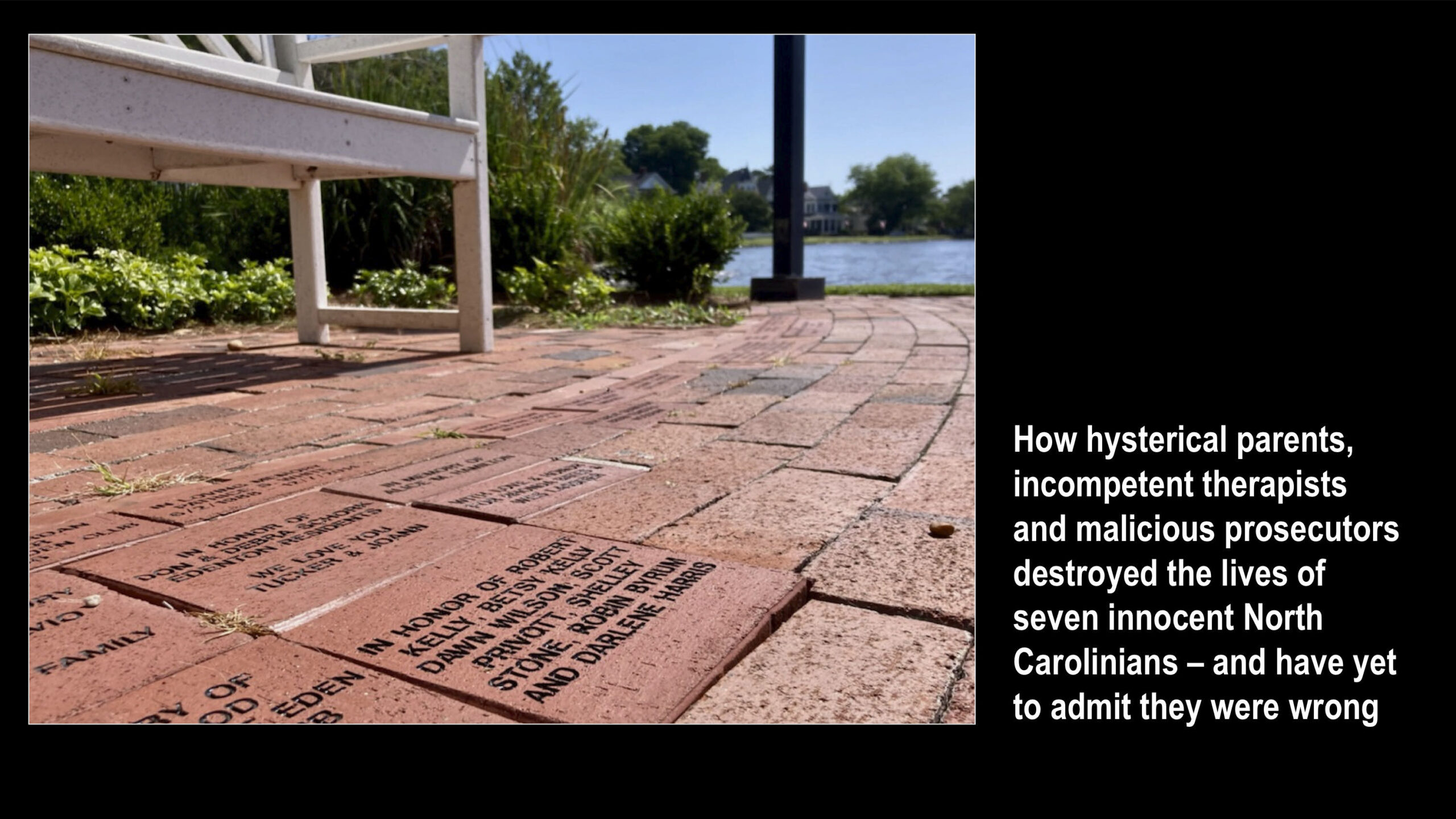
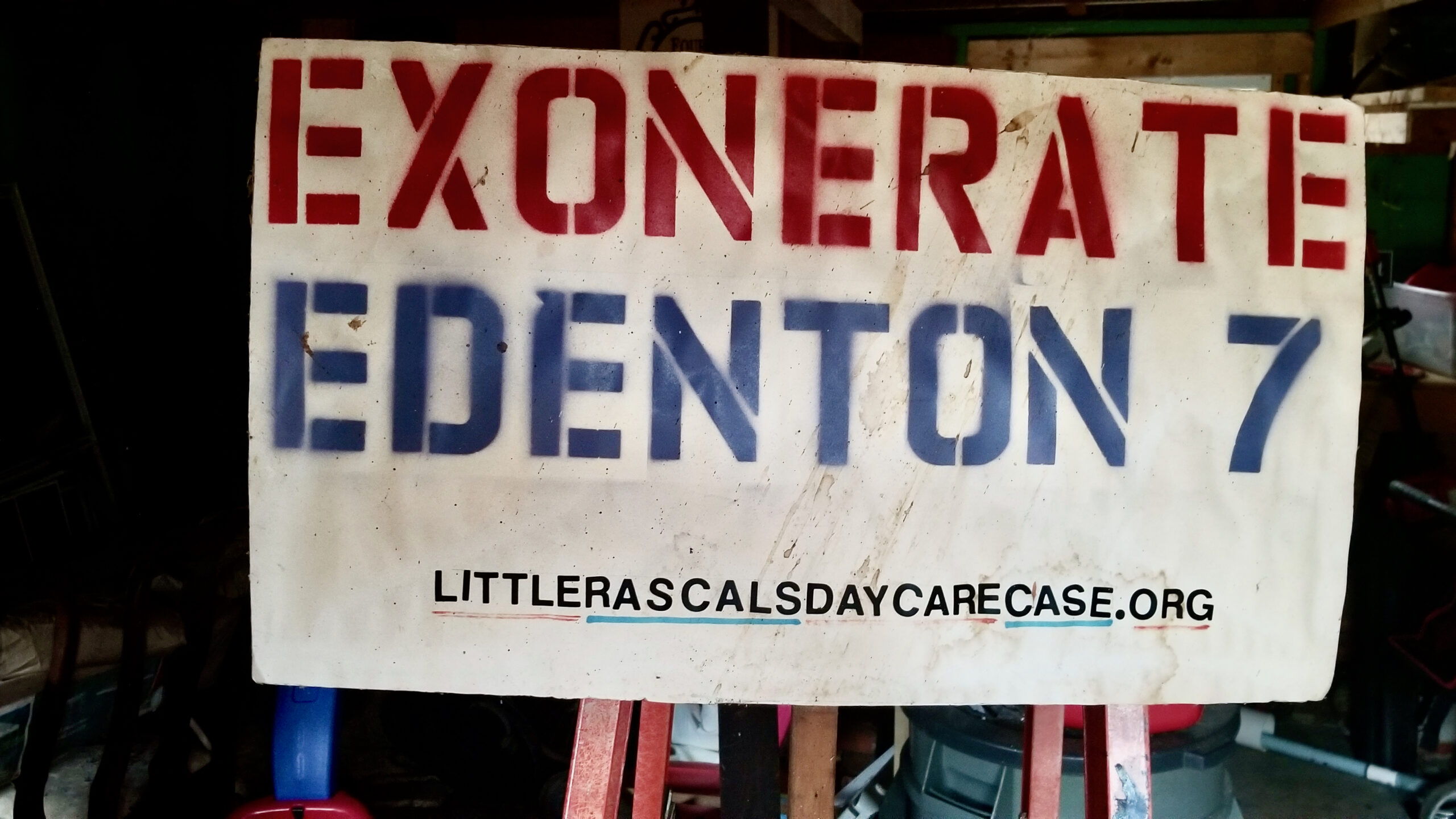
Among the alleged perpetrators: the sheriff and mayor. But prosecutors would charge only Robin Byrum, Darlene Harris, Elizabeth “Betsy” Kelly, Robert “Bob” Kelly, Willard Scott Privott, Shelley Stone and Dawn Wilson – the Edenton 7.
Along with sodomy and beatings, allegations included a baby killed with a handgun, a child being hung upside down from a tree and being set on fire and countless other fantastic incidents involving spaceships, hot air balloons, pirate ships and trained sharks.
By the time prosecutors dropped the last charges in 1997, Little Rascals had become North Carolina’s longest and most costly criminal trial. Prosecutors kept defendants jailed in hopes at least one would turn against their supposed co-conspirators. Remarkably, none did. Another shameful record: Five defendants had to wait longer to face their accusers in court than anyone else in North Carolina history.
Between 1991 and 1997, Ofra Bikel produced three extraordinary episodes on the Little Rascals case for the PBS series “Frontline.” Although “Innocence Lost” did not deter prosecutors, it exposed their tactics and fostered nationwide skepticism and dismay.
With each passing year, the absurdity of the Little Rascals charges has become more obvious. But no admission of error has ever come from prosecutors, police, interviewers or parents. This site is devoted to the issues raised by this case.
On Facebook


Little Rascals Day Care Case
This Facebook page is an offshoot of littlerascalsdaycarecase.org, which addresses the wrongful prosecution of the Edenton Seven and other such victims.

Meanwhile in Edenton....
This content isn't available right now
When this happens, it's usually because the owner only shared it with a small group of people, changed who can see it or it's been deleted.0 CommentsComment on Facebook
Allies for our cause!
This content isn't available right now
When this happens, it's usually because the owner only shared it with a small group of people, changed who can see it or it's been deleted.0 CommentsComment on Facebook
The courts have a long history of capriciously pulling the rug out from under Junior's appeals, but maybe this time....
This content isn't available right now
When this happens, it's usually because the owner only shared it with a small group of people, changed who can see it or it's been deleted.0 CommentsComment on Facebook
Click for earlier Facebook posts archived on this site
Click to go to

Today’s random selection from the Little Rascals Day Care archives….
‘Subculture’ of therapists blamed ritual abuse
 Jan. 16, 2013
“Therapists diagnosing Satanic Ritual Abuse as the cause of their patients’ troubles… often belonged to a subculture within the therapeutic community, where focus on dissociation and multiple personalities were more important than among other clinicians.
“This small minority were involved in the vast majority of ritual abuse allegations with a therapy background. Nevertheless, many elements of the ideas, and some of the practices that seem to have been important in creating SRA-narratives were common among therapists of all kinds: belief in the concept of repression, a view of memory as analogous to a video-tape or computer and (confidence) that hypnosis could be an important tool in unearthing forgotten abuse. This view of memory and memory recovery has been largely dismissed among the community of cognitive psychologists.”
– From “Psychology and the Satanic Ritual Abuse Controversy. A Brief Research Review” by Asbjørn Dyrendal in Skepsis (March 2, 2007)
Still waiting for that ‘huge mea culpa’
Sept. 6, 2013
“The day-care trials couldn’t have happened without the active participation of social workers and therapists. Police authorities relied on the therapists to interpret what the child witnesses were saying, to interview the children and to counsel them about their alleged experiences. One might suppose that the realization that:
- People have been sent to prison for years for crimes that never happened;
- Children had been abused, not by the accused, but by misguided therapists who implanted false memories;
would have created a huge mea culpa among the professionals involved. This hasn’t happened.
“Some have defended their actions, if not the results, on the basis that their hearts were in the right place. Some have excused themselves on the basis that nobody knew any better – that, by golly, nobody could have guessed that rewarding children for making accusations, and questioning them until they did make accusations, might just lead to false accusations.
“And they speak, in self-pitying tones, about the ‘backlash’ – the (presumably) undeserved and irrational criticism that is flung their way.”
– From “The ‘Ritual Abuse’ Panic” at Imaginary Crimes
Mum’s still the word from the prosecution therapists in the Little Rascals case, except for Judy Abbott’s resentful response to the “backlash.”
Responses to N&O op-ed vary dramatically
 Jan. 24, 2014
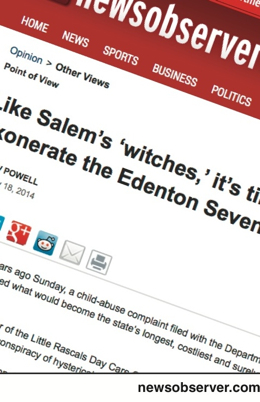
“Powell is right (in this News & Observer column). The state should exonerate those wrongly convicted members of the Edenton Seven and the wrongly accused who were never convicted but had their lives ruined.
“The Innocence Project has freed men wrongly accused of murder or rape, but there seems to be little interest in making amends for those wrongly accused of abusing children, no matter how fantastical the accusations.”
– From “Edenton Seven: hysteria, false accusations, ruined lives” at Erstwhile Editor (Jan. 14)
“It can be hard, in calmer times, to imagine the power of a moral panic like the one in Edenton, itself part of a broader national hysteria. Lisa (Scheer) and I wrote about the case (in Elle magazine) and in our reporting found a community where rational people seemed afraid to dissent from the fantastical narrative.
“As young parents ourselves we were sympathetic to the families we met, but clearly things had gone very wrong in Chowan County.”
– From “Injustice in Edenton” by Edward Cone (Jan. 14)
And three online responses from the N&O:
“A few months after (Bob) Kelly’s release I met him briefly. He had a job maintaining pay phones (for Glenn Lancaster), one of which was located in a pizzeria I was managing.
“I asked him if he was indeed who I thought he was and he said yes. When I told him I believed him and considered the accusations against him ridiculous on their face, he thanked me and appeared to be grateful for the moral support. What struck me was the lowly financial state he seemed to be reduced to and the humiliation he so clearly had to endure.”
– Bruce Henry
“Mr. Powell has forgotten Dorothy Rabinowitz, the Wall Street Journal journalist/commentator who received one of her numerous Pulitzer nominations for a series on the Edenton witch hunts. Those articles were some of the most powerful and insightful I have read in my life. I recall wondering why no North Carolina newspaper had the guts to stand up and condemn the witch trial hysteria and obvious travesty of justice taking place right in their own back yard.”
– James Gamble
Rabinowitz reported heroically on the ritual abuse epidemic, but she focused mostly on cases in Maplewood, N.J.; Malden, Mass., and Wenatchee, Wash., rather than in Edenton.
“I am so glad to know that you were in Edenton at that time and you know exactly what happened. Do you really think a child molester is doing to admit what they did? I don’t think so!!!
“I’m sure you will allow them to baby sit your children or grandchildren.”
– Lu Ann Lewis Barber
Actually, I’d be glad to allow that – what potential babysitter has ever been more thoroughly vetted than the Edenton Seven?
In search of a ‘frank and unblinking appraisal’
 Feb. 20, 2014
Following up on the curious case of Richard Noll v. Psychiatric Times, I wrote editor-in-chief James L. Knoll IV to ask about the removal of Dr. Noll’s “satanic ritual abuse” essay from the Psychiatric Times website.
Did the journal plan to address in some fashion the issues raised in Dr.
Noll’s piece? “Unfortunately, I am not at liberty to comment on the situation,” Dr. Knoll replied.
Next I turned to Psychiatric Times’ editorial board, described on the site as “(not) just figureheads with impressive résumés…. They give us their frank and unblinking appraisal of the contents of each and every issue….”
This is from a letter I sent to 22 PT board members:
“I am writing you in response to Dr. Allen Frances’s call for psychiatrists to ‘step forward and do the right thing’ about the profession’s failure to confront the ‘satanic ritual abuse’ claims of the 1980s and early ’90s.
“As you know, Psychiatric Times removed from its website Dr. Richard Noll’s history of the SRA era….
“Dr. Noll concluded by asking: ‘Are we ready now to reopen a discussion on this moral panic? Will both clinicians and historians of psychiatry be willing to be on record? Shall we continue to silence memory, or allow it to speak?’
“How do you, as a member of the Psychiatric Times editorial board, answer these questions?
“Would you now be willing to join with Dr. Frances in formally setting the record straight about SRA and in making amends to the scores of wrongfully prosecuted victims of the moral panic?”
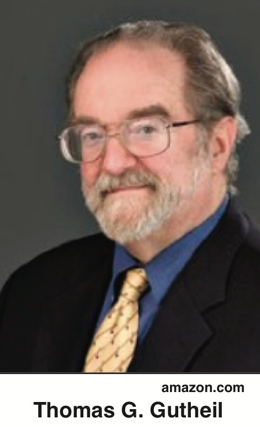
So far I have not been overwhelmed with responses to these questions. In fact, I have received only a single “frank and unblinking appraisal” – from Thomas G. Gutheil, professor of psychiatry, Beth Israel Deaconess Medical Center, Harvard
Medical School.
“I do agree (with Dr. Frances),” he writes. “The 1992 FBI report compiled by Kenneth Lanning should have put an end to this, when he investigated many claimed cases from law enforcement viewpoint and in multiple cases found not a shred of physical evidence, DNA, cells or bloodstains from butchered babies or sacrificed virgins.
“The problem is that social viruses like this are hard to assess and halt, like their biologic counterparts. I agree that individuals, especially in the legal system, should own up to their serious errors and miscarriages of justice, since improved science has blown up many claims, yet some prosecutors (e.g., Martha Coakley in Mass.) have not reversed themselves nor freed the imprisoned.
“However, I am not sure the entire mental health professions should share the blame.”
To be sure, distribution of responsibility among the professions is uneven – the Little Rascals prosecutors called on no psychiatrists at all, only psychologists, off-brand psychotherapists, etc.