Rascals case in brief
In the beginning, in 1989, more than 90 children at the Little Rascals Day Care Center in Edenton, North Carolina, accused a total of 20 adults with 429 instances of sexual abuse over a three-year period. It may have all begun with one parent’s complaint about punishment given her child.
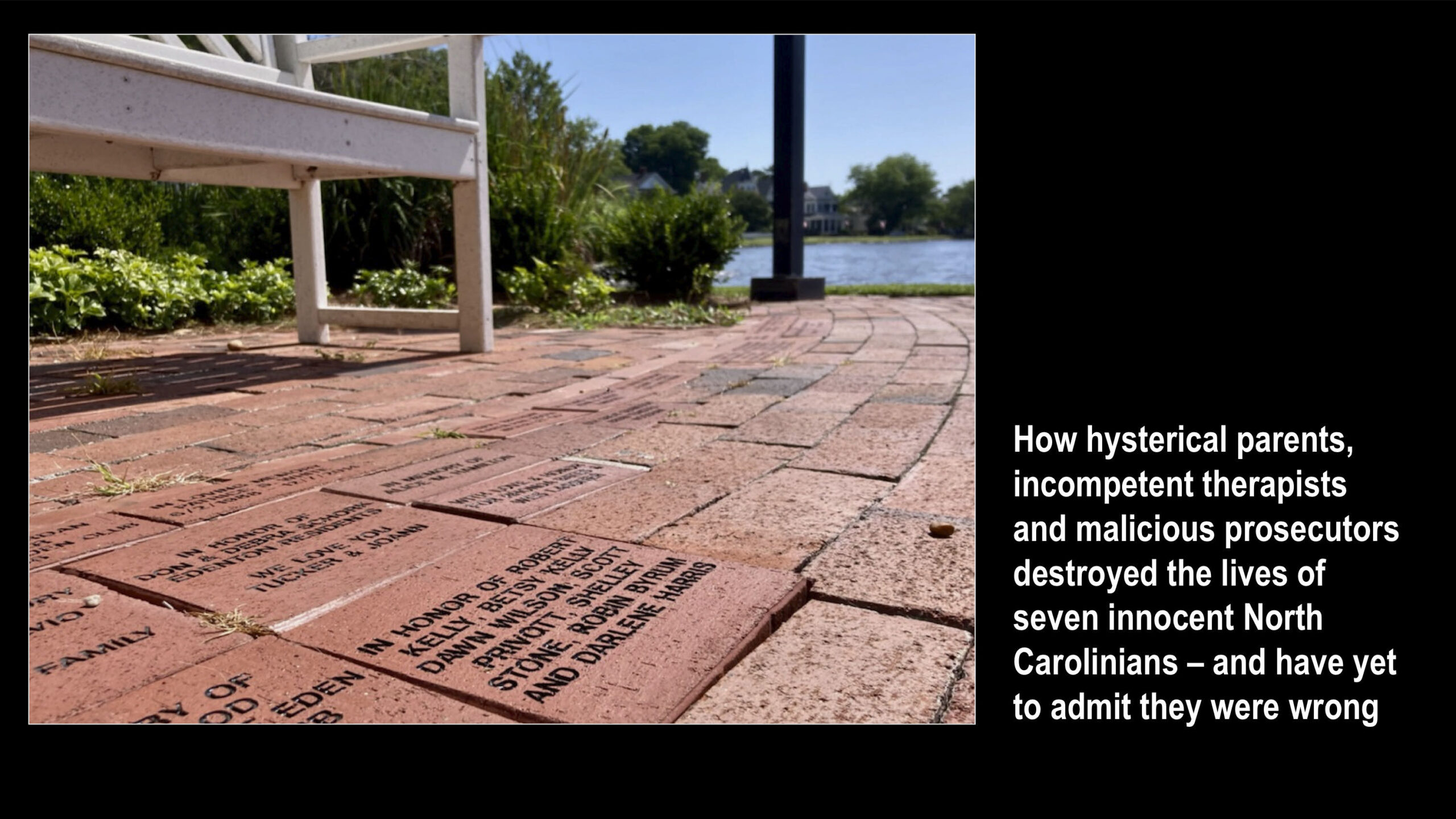
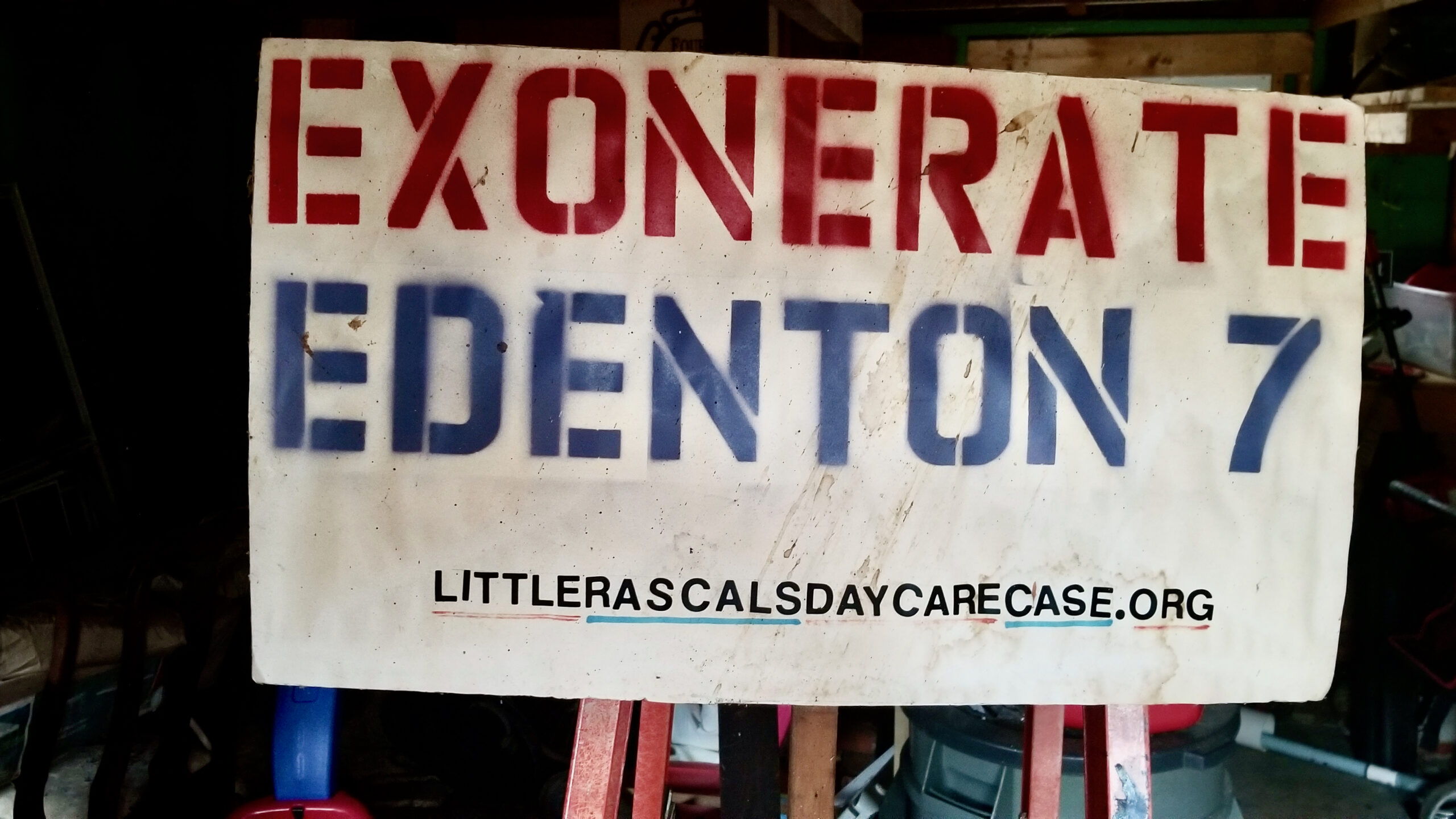
Among the alleged perpetrators: the sheriff and mayor. But prosecutors would charge only Robin Byrum, Darlene Harris, Elizabeth “Betsy” Kelly, Robert “Bob” Kelly, Willard Scott Privott, Shelley Stone and Dawn Wilson – the Edenton 7.
Along with sodomy and beatings, allegations included a baby killed with a handgun, a child being hung upside down from a tree and being set on fire and countless other fantastic incidents involving spaceships, hot air balloons, pirate ships and trained sharks.
By the time prosecutors dropped the last charges in 1997, Little Rascals had become North Carolina’s longest and most costly criminal trial. Prosecutors kept defendants jailed in hopes at least one would turn against their supposed co-conspirators. Remarkably, none did. Another shameful record: Five defendants had to wait longer to face their accusers in court than anyone else in North Carolina history.
Between 1991 and 1997, Ofra Bikel produced three extraordinary episodes on the Little Rascals case for the PBS series “Frontline.” Although “Innocence Lost” did not deter prosecutors, it exposed their tactics and fostered nationwide skepticism and dismay.
With each passing year, the absurdity of the Little Rascals charges has become more obvious. But no admission of error has ever come from prosecutors, police, interviewers or parents. This site is devoted to the issues raised by this case.
On Facebook


Little Rascals Day Care Case
This Facebook page is an offshoot of littlerascalsdaycarecase.org, which addresses the wrongful prosecution of the Edenton Seven and other such victims.

Meanwhile in Edenton....
This content isn't available right now
When this happens, it's usually because the owner only shared it with a small group of people, changed who can see it or it's been deleted.0 CommentsComment on Facebook
Allies for our cause!
This content isn't available right now
When this happens, it's usually because the owner only shared it with a small group of people, changed who can see it or it's been deleted.0 CommentsComment on Facebook
The courts have a long history of capriciously pulling the rug out from under Junior's appeals, but maybe this time....
This content isn't available right now
When this happens, it's usually because the owner only shared it with a small group of people, changed who can see it or it's been deleted.0 CommentsComment on Facebook
Click for earlier Facebook posts archived on this site
Click to go to

Today’s random selection from the Little Rascals Day Care archives….
‘The most fundamental questions of fairness’
July 5, 2013
“RALEIGH – During a hearing at the state Court of Appeals, Chief Judge Gerald Arnold repeatedly asked a state prosecutor about the fairness of testimony by (Bob) Kelly’s former attorney in Edenton. Arnold said the attorney had, in effect, testified that he believed in Kelly’s innocence until he learned his child had been abused.
“ ‘How can you argue that it was not extremely prejudicial?’ the judge asked.
“Associate Attorney General Ellen Scouten argued that Chris Bean did not divulge confidential information and did not violate an attorney-client relationship with Kelly. She said Bean testified as a parent and a crime victim.
“Arnold said Bean, now a district court judge, had gone beyond describing what he had seen and witnessed as a parent.
“ ‘This boils down to the most fundamental questions of fairness,’ Arnold said. ‘When you have an attorney testifying that “I was Mr. Kelly’s attorney and I believed in him very strongly until I learned the truth, that is to say that he’s guilty, and then I was shattered.” How can there be more prejudicial, stronger evidence put before a jury than to have a former attorney, the defendant’s attorney say that?’
“Scouten said that because the defense had contended that accusers in Edenton were hysterical people on a witch hunt it was fair to allow the state to show the type of people involved.
“ ‘Mr. Bean and his wife were reputable, respected thoughtful, educated people – not the type of people that would be swept up by community hysteria,’ she said.”
– From “Appeal of 2 defendants in Little Rascals case draws a crowd” in the News & Observer (Jan. 10, 1995)
Given this line of questioning, it came as no great surprise when four months later the Court of Appeals overturned the convictions of both Kelly and Dawn Wilson.
Bean’s unfettered opinionating was only one of three major defects cited by the court, the others being the withholding of exculpatory evidence by prosecutors and the testimony of parents as expert witnesses.
The prosecution got off light – the brief filed by appellate defender Mark Montgomery claimed no fewer than 222 potentially reversible errors.
You had to have been there (or did you?)
Sept. 25, 2013
“Peer group pressure… is a factor that should be considered when there is an allegation of sexual abuse involving multiple victims. Children in Edenton who never attended the day care, but who had peers who attended, claimed to have been abused at the day care.
“During her testimony for the defense, Dr. Maggie Bruck described a scientific study in which two actors went into a classroom of 28 children to give a talk. During the talk one of the actors knocked a large birthday cake off a piano. Seven children had been removed from the room and did not observe the event. Later when the children were interviewed six of the seven children who had not been present not only claimed to have been there but described the event as if they had been present.”
– From “Evidence Issues and ‘Lessons’ from State v. Kelly: Litigation of Allegations of Child Sexual Abuse” by Jeffrey L. Miller and W. Michael Spivey, presented at the 6th annual North Carolina Criminal Evidence Seminar, UNC School of Law (April 16, 1993)
Ritual-abuse mania contaminated legitimate prosecutions
June 27, 2012
“When well-intentioned but misguided individuals use questioning techniques known to increase the risk of false allegations of sexual abuse, a cascade of unfortunate events can follow.
“Consequences of corruptive interview techniques include the risk of innocent individuals being falsely accused as well as abused children not being believed.”
– From “Forensic Issues in Child Sexual Abuse Allegations” by Charles L. Scott, M.D., in Psychiatric Times (December 1, 2008)
Scott points out a seldom-mentioned but potentially tragic after-effect of the day-care ritual-abuse mania: A loss of credibility for children who actually have been sexually abused. The clouds labeled “McMartin” and “Little Rascals” now hang over every such prosecution.
Prosecutors staged revival of ‘spectral evidence’
 April 5, 2013
“In the Little Rascals Day Care case testimony was given about children being attacked by sharks kept in a pool by the accused. No prosecutor believed this story, and had such tales been told by adults, their credibility would have been laughed at…. However, (two Edenton defendants) were convicted, because under a new precedent, obviously false stories by children were set aside in the minds of prosecutors and juries, because of the belief that testimony from children needed to be treated differently….
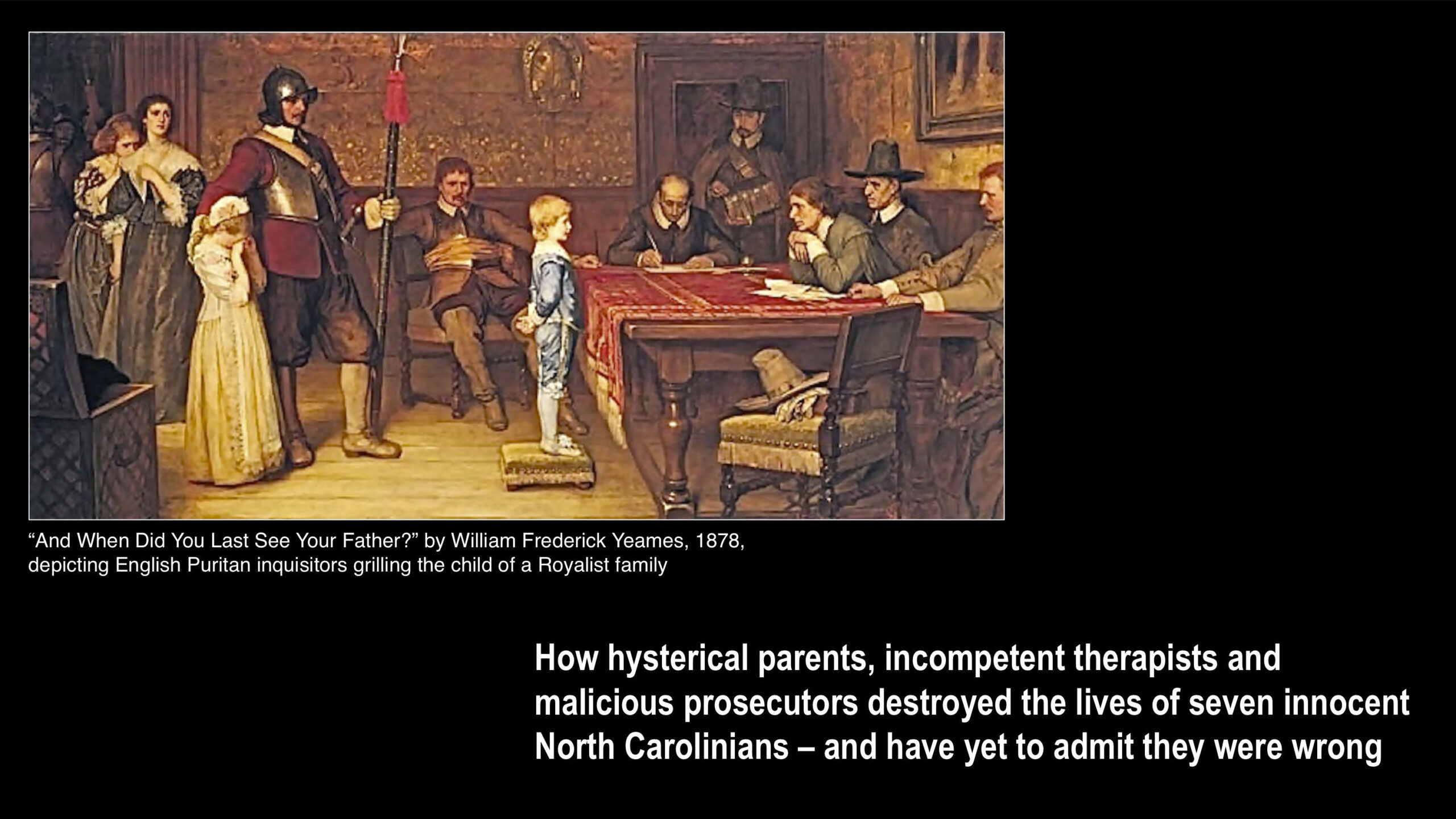
“In (the Salem Witch Trials of) 1692, as in the modern day-care cases, the heart of the episode was the claims of the accusers versus the denials of the accused. Jurors were forced to choose between two sets of competing claims with no independent verification for any of them. Although not all the accusers were children, many were, and the idea of protecting the children played a heavy role in the prosecutions.
“Accusers claimed that the specters of the accused hurt them…. This kind of uncorroborated evidence became known as ‘spectral evidence,’ and on the basis of that evidence convictions routinely occurred. Contrary to popular, modern representations, all this took place in an orderly manner in a special court set up to investigate the outbreak. Within the rules of the day, the accused people had fair trials, just as the (day-care defendants) had a fair trial.
“What brought the trials to an end was the growing belief by the elites in Massachusetts Bay Colony, especially the clergy, that spectral evidence could not be trusted…. The trials continued, but under a new court where spectral evidence was not admissible, (and) the convictions largely stopped….”
– From “No Finality in Fells Acres” by Bernard Rosenthal, author of “Salem Story: Reading the Witch Trials of 1692”
“In spectral evidence, the admission of victims’ conjectures is governed only by the limits of their fears and imaginations, whether or not objectively proven facts are forthcoming to justify them. (State v. Dustin, 122 N.H. 544, 551 (N.H. 1982)).”
– From “Spectral Evidence Law & Legal Definition”
“Governed only by the limits of their fears and imaginations” – doesn’t that nail it!