‘Have you ever stopped to consider…?’

July 31, 2013

“Have you ever stopped to consider what the statistical odds must be against the following allegations made by the prosecution? How could the following all be true?

“1. That seven child abusers would somehow all show up at the Little Rascals Day Care during the same time period.

“2. That out of these seven alleged abusers not one had any record of any sexual misbehavior in their past.

“3. That out of all seven of these alleged abusers not one was found to be in possession of any child pornography or other suggestive materials.

“4. That with multiple-hundreds of alleged abuses claimed to have taken place, not one single piece of ‘hard’ evidence was ever found. Nor was there a single adult witness to any behavior even suggestive of abuse.

“5. That out of all seven of these alleged abusers, not one would be willing to testify against the others in return for easier treatment.”

– From a Feb. 22, 1994, letter sent to prosecutors and the press by Jeffrey Keimer of Portola Valley, Calif.

These are questions that occurred to someone following the Little Rascals case from 3,000 miles away. Too bad they seem not to have occurred to so many prosecutors, therapists, parents, reporters and jurors. Up close, was the “ritual abuse” narrative simply too mesmerizing?
Of mice and memory and the moral panic

July 29, 2013

“Scientists at the Massachusetts Institute of Technology have developed the ability to implant mice with false memories. The memories can be easily induced and are just as strong as real memories, physiological proof of something psychologists and lawyers have known for years.

“The findings are a serious matter. According to the Innocence Project, eyewitness testimony played a role in 75 percent of guilty verdicts eventually overturned by DNA testing after people spent years in prison. Some prisoners may even have been executed due to false eyewitness testimony. It was not because the witnesses were lying. They were just wrong, said Susumu Tonegawa, a molecular biologist and the lead author in the MIT study.

“In the longest criminal trial in American history, the McMartin family, who operated a preschool in California, was charged with multiple incidents of child abuse. After seven years and $15 million in prosecution expenses, some charges were dropped and the defendants were acquitted of others when it became clear some of the accusations were based on false memories, some possibly planted by childrens’ therapists.”

– From “Scientists Produce False Memories In Mice” by Joel N. Shurkin, Inside Science News Service (July 25, 2013)

The same day’s Guardian of London adds this response from Chris French, head of the Anomalistic Psychology Research Unit at Goldsmiths, University of London:

“Memory… is a reconstructive process which involves building a specific memory from fragments of real memory traces of the original event but also possibly including information from other sources.”

“Information from other sources” – that is, from prosecution therapists – was what contaminated the memories of child witnesses in cases such as McMartin and Little Rascals.

For Betsy Kelly’s sister, a chillingly close call

130429Barrow2July 26, 2013

Rereading appellate defender Mark Montgomery’s thunderously compelling brief on behalf of Bob Kelly always delivers something I had either passed over earlier or forgotten. This time it was that

“(Jimmy) and Nancy Smith also declined to have their son Judson evaluated by one of the four therapists who saw the other children. By the time of trial, both Mr. and Ms. Smith had been accused by several children as having participated in the abuse. (One of the child-witnesses) said of Nancy Smith, ‘She’s Miss Betsy’s sister, so she must be mean.’ ”

The Smiths’ close call highlights once again the terrible randomness of the Little Rascals prosecutors’ accusation process.

How challenging the prosecutors’ decision-making must have been: Which child-witness had been adequately manipulated, and which couldn’t be counted on to earnestly describe the sharks, the butcher knives and the dead babies? Which innocent adult was vulnerable, and which might strike jurors as just too unlikely a serial ritual-abuser?

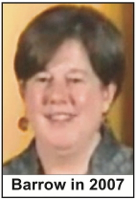
Nancy Smith (Barrow) recalls today that “I had NO idea I had been accused until working with (defense attorneys) Mike Spivey and Jeff Miller for Bob’s trial.  I happened to read some notes from police interviews and saw my name more than once….

“No member of my family – mother, father, Laura, Leslie, or Judson – was ever interviewed by police or prosecutors.  Jimmy and I talked with Brenda Toppin one afternoon in her office.  She only wanted to know about the state of Bob and Betsy’s marriage.”

Officer Toppin sure had an eye for ‘red flags’

July 24, 2013

“(Edenton police officer Brenda) Toppin, who conducted the first interviews of children allegedly abused at the center, testified that ‘In the early interviews, I had very few children disclosing to me…. Most of the children were not telling me specifically about Mr. Bob.’

“ ‘Red flags,’ however, caused her to continue her questioning. The ‘red flags’ included children being tense when the subject of the day-care center was mentioned, she said, and not talking to her as normal children would.”

– From the Associated Press (December 4, 1991)

It doesn’t take much reading between the lines to see Brenda Toppin’s persistence in the face of “very few children disclosing to me” or her overreaction to those absurdly vague “red flags.”

A surviving fragment of tape laid out even more saliently her abusive interview technique. Read for yourself a transcript of one of Toppin’s interviews with a child. The transcript entered the court record during the appeals process.

Claims were extraordinary, but evidence wasn’t

July 22, 2013

“Precisely because of human fallibility, extraordinary claims require extraordinary evidence. Now, I know that (alien-abduction theorist) Budd Hopkins responds that extraordinary claims require extraordinary investigations. And I have two kinds of responses to that.

“There is a claim that a brontosaurus is tramping through the jungles today in the Republic of Congo. Should a massive expedition be mounted with government funds to find it, or it is so implausible as not to be worth serious sustained systematic attention?

“My second point is that to the extent that extraordinary claims require extraordinary investigations, those investigations must be true to the spirit of science. And that means highly skeptical, demanding, rigorous standards of evidence. There’s not a hint of that from alien abduction enthusiasts.”

– From “Carl Sagan on Alien Abduction” on NOVA (Feb. 27, 1996)

I’m just trying to imagine the Little Rascals prosecutors and therapists conferring after a long day of bullying 3-year-olds and asking themselves whether their investigations had been “true to the spirit of science.”

What was learned from Little Rascals debacle?

July 19, 2013

“…There should be lessons here, lessons about the risks in cases so emotional that they take on a life of their own; lessons for prosecutors who need to use their considerable investigative resources to learn, and not to crusade; lessons about the price in credibility paid by a judicial system in which defendants who are not rich are up against tremendous odds….

“The Little Rascals case…. has wasted many years of many lives. The greater waste will be if nothing is learned from it.”

– From “Case dismissed” (News & Observer editorial, May 28, 1997)

The toxic legacy of phony scholarship

July 17, 2013

“Some reports of day care abuse suggest threats and verbal coercion to be particularly severe. (David) Finkelhor et al. (1988), for example, reported that in day care abuse, perpetrators threatened harm to the child in 41% of cases, harm to the child’s family in 22% of cases and threatened to kill a child’s pet in 12%. (Susan J.) Kelley, Brant and Waterman (1993) added that threats in these cases were most likely to involve harm to the victim or their family. (Kathleen Coulborn) Faller (1990) notes that in addition to death threats against the victim or their family, a further frequent threat was to implicate the victim.”

– From “Women Who Sexually Abuse Children” by Hannah Ford (2006)

So much so wrong in so few words!

Finkelhor, Kelley and Faller – among their era’s most prolific researchers in child sexual abuse – have never retracted their false claims. And despite epochal advances in social science, author Ford in 2006 cites their work without qualification, thus extending its influence to another generation.

Notable also: As does fellow fantasist Susan J. Kelley, Finkelhor uses statistics to lend authority to his alternate universe. How many “perpetrators… threatened to kill a child’s pet”? Not 10 percent, not 11 percent, but “12 percent” – who could doubt such exactitude?

Ritual-abuse theorist played ‘concentration camp’ card

July 12, 2013

“Some professionals take the charges (of satanic ritual abuse) seriously. ‘It’s hard to believe, but so were the reports about Nazi atrocities,’ says Bennett Braun, director of the Dissociative Disorder Program at Chicago’s Rush-Presbyterian-St. Luke’s Medical Center. ‘Then we found the concentration camps.’

“Skeptics are still waiting for the equivalent to a concentration camp to be found. No investigation has ever turned up so much as a bloodstain that could be traced with certainty to these bizarre activities.

“What’s indisputable is the existence of a busy network of therapists specializing in SRA. ‘These allegations are produced by the unrelenting pressure of the therapist,’ says Richard Ofshe, a professor of sociology at the University of California, Berkeley, who studies cults and thought control. ‘You will eventually come up with bizarre stuff because you run out of all the ordinary stuff.’ ”

– From “Rush to Judgment” in Newsweek (April 19, 1993)

As Newsweek’s secondary headline noted, “America is now at war against child abuse. But some recent cases suggest we may be pushing too hard, too fast.” Among the prosecutions criticized was Little Rascals, but by this time both Bob Kelly and Dawn Wilson had been convicted and imprisoned.

Unlike so many others who fomented the ritual abuse/repressed memory/multiple personality mania, psychiatrist Braun actually suffered consequences: He lost his medical license for two years and was among the defendants in a malpractice suit ultimately settled for $7.5 million. He now practices in Butte, Montana.

For maximum notoriety, avoid Chowan County

July 10, 2013

Although some consider Little Rascals the East Coast version of the McMartin case, according to Google’s nGram Viewer it comes in a distant second in prominence.

Not even eight hours of “Innocence Lost” could make up for McMartin’s having been tried first and for its having been situated in Southern California rather than in Eastern North Carolina.

Prosecutor reneged on promise to Betsy Kelly

111202HartJuly 8, 2013

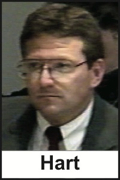
“As the parents made their case to the (North Carolina Parole Commission), prosecutors and defense attorneys continued sparring over whether the state had reneged on the plea bargain by trying to block (Betsy) Kelly’s parole.

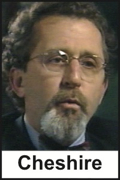
“Kelly’s attorney, Joe Cheshire V, says prosecutor William Hart promised not to contest her parole if she agreed to the no-contest plea. Hart says the state never made such a pledge.

“Hart and assistant prosecutor Nancy Lamb attended the hearing to support the parents. They say it would be inappropriate for Kelly to be released, because she continues to publicly proclaim her innocence.

“ ‘The parents know she is guilty,’ Lamb told reporters before the hearing. ‘They know what their children have gone through.’

“Cheshire, continuing to maintain his client’s innocence, said Hart should have tried Kelly in court if he wanted to show she was guilty.

“ ‘He was afraid to do that,’ Cheshire said. ‘And now he’s running around saying that since she won’t admit her guilt, she should not get paroled. I think that’s pretty pathetic.’ ”

– From “Parents oppose parole for Little Rascals operator” in the News & Observer (April 12, 1994)

Pandering, bullying, grandstanding, double-crossing – in thwarting Betsy Kelly’s parole, the Little Rascals prosecutors scored a grand slam of misfeasance.

Here’s what Joe Cheshire recalls about that brutal day:

120716Cheshire“Simply taking that plea was distasteful to me, but when the awesome power of government meshes with the awesome power of the judiciary and neither want to find the truth, but instead to consummate a decided outcome, the individual gets ground up in the process.

“Betsy was desperate to come home and did not trust anyone, nor should she have.  I am not a fool; I would not have agreed to such a plea if it did not insure her freedom.  The only (apparent) risk was the Parole Board.  The prosecutor had agreed to not oppose her parole, but then he reneged.  He knew that our only alternative was to move that the plea be set aside and that we would not be in a position to do that.

“Yes, in retrospect I should not have trusted him….  But he was not willing to put it in writing, and (insisting on that) would have ended the negotiations….”

Little Rascals prosecutors seemed perversely unable to let any defendant go home without administering a final cheap shot. When Scott Privott was released under a no-contest plea deal in 1994, they added a last-minute stipulation that he undergo psychiatric evaluation as part of his five-year probation.

“I saw them weekly for about two months,” Privott recalls, “and then they reported that I was normal. My probation officer told me (Bill) Hart was pissed… and that was that.”