Edenton Seven could’ve used a Johnny Depp

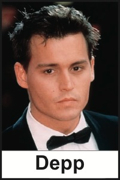
120910DeppSept. 10, 2012

“You saw those initial documentaries, you make a choice: Am I going to watch the thing and go ‘Wow, that’s really horrible,’ and go out and get a milkshake?”

– Johnny Depp, tracing the roots of his advocacy for the West Memphis Three

That could be me talking – except that the eye-opening documentaries for me were “Innocence Lost” rather than “Paradise Lost,” that I’m a retired newspaperman rather than a Hollywood actor and – most crucial – that I went out for a figurative two-decade milkshake run rather than responding immediately to the outrage I was seeing on screen. Hats off to WM3 advocates such as Depp, who moved quickly to challenge prosecutors every bit as recalcitrant as those in North Carolina.
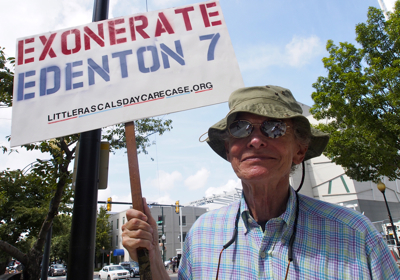
City sidewalks, busy sidewalks: An upbeat dispatch from the DNC

Sept. 7, 2012

Having met with less than overwhelming interest earlier in the week in front of the bustling Charlotte Convention Center, I narrowed my focus.

Thursday I situated my “Exonerate” placard at the entrance to the peripheral and unhurried Crowne Plaza hotel, convention headquarters for the North Carolina Democratic Party, and our message was well received (except for an overly territorial security guard).

Not only did several delegates express support for the Edenton Seven, but also a dozen or so more took cards with the site address. And I was able to bend the ears of reporters from Greensboro, Rocky Mount and the Outer Banks, as well.

Yes, the delegates are mostly ordinary folks, not influential officials – I didn’t see Gov. Perdue – but I’m grateful they will take home a greater awareness of this shameful injustice, still unaddressed, in their own state.

Predigital advocacy for the Edenton Seven

Author outside Charlotte Convention Center.

Sept. 5, 2012

Almost 68 years old I am, but until this week I had never hoisted a picket sign. Why now?

Within walking distance of my house, thousands of delegates and reporters are attending the Democratic National Convention. A moment of attention perhaps for littlerascalsdaycarecase.org?

Most of those striding along the sidewalk in front of the Convention Center barely glanced at my carefully stenciled placard, but occasionally someone asked about the case and accepted a card. Jim Morrill of the Charlotte Observer even gave me a mention on his blog.

What I have learned: As a media magnet, I’m no match for a white-bearded guy bearing a six-foot cross (on rollers) and two wooden tablets.

Postcard from the bumpy path to exoneration

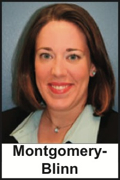
120903Montgomery-BlinnSept. 3, 2012

Since its creation by the General Assembly in 2006, the North Carolina Innocence Inquiry Commission has considered more than 1,100 innocence claims, three of which resulted in exonerations.  This is from a letter I wrote the Innocence Inquiry Commission requesting that it take up the case of the Edenton Seven:

“I am fully aware that my request falls outside the letter of your mandate. It is of such importance, however, that I believe consideration by the Commission would be both just and appropriate.”

And this is from the response I received from Kendra Montgomery-Blinn, executive director:

“By law the Commission is only permitted to consider claims arising from current convictions. We cannot consider cases in which the conviction was vacated, even if the claimants were not fully exonerated.

“I am familiar with the (Little Rascals) case as I studied it both in college and in law school. In fact, I cited the case in the brief for a 2007 Commission hearing….

“I am sorry that the Commission cannot be of further assistance. The only other option I am aware of is a Gubernatorial pardon. The surviving defendants from the Wilmington 10 case have recently applied for pardons.

“Thank you for contacting the Commission and for continuing to bring attention to this important case and the subject of wrongful convictions. I am proud that North Carolina is first in the nation to have a state-run innocence commission.”

Another door to exoneration is closed, however sympathetically. Others remain.

Footnote: The hearing Ms. Montgomery-Blinn mentions grew out of a 2001 case in Pitt County. Henry Reeves had been convicted of taking indecent liberties with his 6-year-old daughter, Marquita. This passage in the Innocence Commission’s investigative statement caught my eye:

“Barbara Hardy (the child’s mother and the defendant’s wife) stated that when Marquita came out of her sessions with Dr. (Betty) Robertson, Marquita would have gum or little presents, and Marquita would state ‘Look what she gave me for getting the questions right.’

“Mrs. Hardy said that she tried to tell Dr. Robertson that Marquita was a people pleaser  and may say things just to be rewarded, but Dr. Robertson said, ‘I believe it happened, and it’s going to court.’

“It is important to note that Dr. Robertson…. provided therapy and evaluations to 23 of the children in (the Little Rascals) case….”

Still rewarding possibly-abused children for “getting the questions right”?  Did Betty Robertson learn nothing from the 23 false positives she reported in Edenton?

There was good reason children weren’t eager to accuse

Aug. 31, 2012

“Children don’t just come running out of their houses screaming, ‘I’ve been molested!’”

– Assistant attorney general Bill Hart, justifying to the Associated Press (Dec. 31, 1989) why the prosecution’s serial allegations were taking so many months to come to light.

In a case typified by overstatement, Hart’s excuse for delay proved to be a most revealing understatement. Those children resisted mightily and at length before being manipulated into “screaming, ‘I’ve been molested!’”

What caused ‘inability to think straight’?

Aug. 29, 2012

“Los Angeles County’s Satanic Abuse Task Force, an official sub body of the Los Angeles County Women’s Commission, concluded (in 1992) that Satanists were trying to pump diazinon poison into their office and home air vents in order to silence them. Task force members became suspicious, according to president Myra Rydell, after experiencing bouts of profound exhaustion, headaches and, perhaps most significantly, ‘the inability to think straight.’

“McMartin parent Jackie McGauley, also a task force member, told a reporter that, according to her doctor, diazinon would be ‘virtually impossible to detect’ if given in small doses over a long time period. The County’s epidemic specialist said that diazinon was easy to detect and after his own investigation called the claims ‘outrageous.’”

– From “The Dark Truth About the ‘Dark Tunnels of McMartin’” by John Earl (IPT Journal, 1995)

No single reason accounts for the country’s belated skepticism about ritual abuse, but the poison-gas episode in Los Angeles surely qualified as a “jump the shark” moment.

‘Prosecutors’ Overreaching’? Edenton had it in spades

Aug. 27, 2012

“Prosecutors are the most powerful officials in the criminal justice system. They decide whether criminal charges should be brought and what those charges should be, and they exercise almost boundless discretion in making those decisions. Prosecutors alone decide whether to offer the defendant the option of pleading guilty to reduced charges….

“Equally problematic is that the charging and plea-bargaining decisions are made behind closed doors, and prosecutors are not required to justify or explain these decisions to anyone…. The lack of transparency also leads to misconduct, like the failure to turn over exculpatory evidence – a common occurrence made famous by the prosecutors in the Duke lacrosse and Senator Ted Stevens cases.”

– From “Prosecutors’ Overreaching Goes Unchecked” by Angela J. Davis in the New York Times (Aug. 19)

Prosecutors plea-bargained cruelly though futilely with the Edenton Seven. And while the evidence-withholding in the Duke and Stevens cases may have made bigger headlines, it was no more flagrant than in Little Rascals.

One example from the North Carolina Court of Appeals order overturning Bob Kelly’s conviction (May 2, 1995):

“Judge L. Bradford Tillery, a pretrial Judge, directed the State to file and present for in camera review identifying information, medical and psychotherapeutic files and DSS files with respect to the ‘indictment children’….

“In apparent compliance with Judge Tillery’s order… the State turned over a box of files to the trial court, Judge McLelland presiding. The box contained, inter alia, complete medical notes and therapy notes on the 29 indictment children, 12 of whom testified at defendant’s trial and 17 of whom did not….

“After trial, defendant’s appellate counsel went to the Office of the Clerk of Court for Pitt County to view the exhibits. He opened several boxes containing trial exhibits, none of which were sealed. One of the boxes contained 29 files labeled with the names of the indictment children. Appellate counsel reviewed some of the documents contained in the files before requesting the box to be sealed and transmitted to the Court of Appeals…. Defendant argues that the files contained undisclosed information that would have been material to the defense.”

In fact, the withheld files were bulging with exculpation – conflicting claims, evidence of hysteria, eyewitness testimony that nothing happened. Countless other examples are documented in Bob Kelly’s appeal brief.

Attorney General Mike Easley bridled at the appeals court’s concern over such “small areas… none of which are very significant.” And, after all, as prosecutor Bill Hart had asked smirkingly during the trial, “If you were playing poker, would you be playing with your full hand showing?”

‘I knew right then it couldn’t be true’

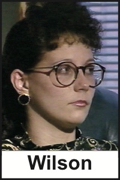
120312WilsonAug. 24, 2012

My EDENTON7 license plate recently caught the eye of a former Little Rascals Day Care parent who left Edenton.

Although Maria – a pseudonym, as she still has family back home – withdrew her daughter from Little Rascals in 1989 after less than two months, it was because of outside circumstances, not because of any dissatisfaction with the care received. “It was a normal day care, clean and quiet,” she says.

The torrent of ritual-abuse rumors started soon after.

She was unsure what to make of it all until a former classmate, Dawn Wilson, was caught up in the dragnet. “Dawn had sat in front of me in high school,” she recalls. “She was quiet and shy, but she opened up to me about wanting to have a baby. She was a loving person. When I heard her name mentioned, I knew right then it couldn’t be true.”

Maria worked at Hardee’s, where she found it “painful to watch” Betsy Kelly’s parents, Warren and Alice Twiddy,  being ostracized by their Wednesday-morning coffee klatch. “They were respected people…. She was the clerk of court. It was like she couldnt believe the town was doing this to her.”

Maria’s most surprising observation: “I think PBS (“Frontline”) changed the minds of a lot of people in Edenton. They saw how the gossip and innuendo had worked.”

Even Betsy Kelley believed something happened

120821KellyAug. 22, 2012

“They would have had to experience this or seen this. I know that for a fact. I know they didn’t make it up. I mean, I’m an intelligent person….

“I feel very sure in my heart and in my mind that this happened…. but not with Mr. Bob and not at the day care.”

– Betsy Kelly, demonstrating (in an interview taped by Officer Brenda Toppin, March 16, 1989) the pervasiveness of the impulse to “Believe the Children”

Beware the next generation of Indian captivity tales

Aug. 20, 2012

Endlessly fascinating – and baffling – is how some experts fell headlong for “satanic ritual abuse,” while others managed to keep their wits. This is from an April 25, 1989, Associated Press story:

“David G. Bromley, a sociologist at Virginia Commonwealth University in Richmond, Va., sees not an increase in satanic crime, but a ‘cult scare’ that has more to do with urban legends and modern psychology than with criminology.

“‘I think it’s all a hoax,’ says Bromley, who investigated allegations of cult ‘brainwashing’ in the 1970s that were never proven.

“Bromley says rumors about rings of adults who start day care centers to find children to abuse in satanic rituals are ‘sheer fantasy’ – but fantasy fed by reports of real child abuse and by today’s parents’ guilt and fears of entrusting their children to strangers.

“‘It is not coincidental that allegations of satanic conspiracies are centered on day care centers,’ he says.”

April 25, 1989! Bob Kelly was attending his probable cause hearing. The first McMartin trial was still ongoing. Stephen Ceci and Maggie Bruck were six years from publishing their landmark “Jeopardy in the Courtroom: A Scientific Analysis of Children’s Testimony.” So how was David Bromley able to see through the fog?

“This kind of ‘subversion episode’ is not new,” he told me recently. “There has been one every few decades in American history. The focus has changed but not the phenomenon. Indian captivity tales, Salem witch trials, drug scares, communist scares, immigrant scares, UFO scares.

“There has always been some group or coalition that has found social insecurities a way of advancing its own status. In this case police and therapists made careers out of the episode.

“The story was only plausible for a limited period, and these kinds of events tend to implode eventually. But there are a lot of casualties in the meantime.

“It will happen again, I am sorry to say.”

And when it does…?