When millions believe in alien abduction….

Jan. 25, 2013

“With regard to recovered memories, ritual abuse charges and multiple personalities, the tide seems to have turned. Courts are continuing to reverse decisions…The Edenton Seven have been released from prison…. Yet many of these people’s lives have been wrecked by false allegations….

“If, as some polls claim, millions of Americans believe in alien abduction, we have a long way still to go before credulity, superstition and hysterical epidemics are on the wane…”

– From “Hystories: Hysterical Epidemics and Modern Media” by Elaine Showalter (1998)

‘Burying the memory’: Misconception that won’t die

130123NathanJan. 23, 2013

“Ritual sex abuse is back. Recently (in 2003) I heard that a conference on the topic was being held for psychotherapists.

“It was planned not to critique a nasty period in the annals of American hysteria but rather so that attendees could learn to ask patients if they’ve ever been raped in day care by secret devil worshipers.

“This stuff was debunked in the 1990s as a type of urban myth. Yet it keeps cropping up, complete with pseudo-scientific theories about the psychology of so-called victims – theories that likewise refuse to die.

“One such theory is that children who are molested often grow up to deny that the crime ever happened. Many do so, the theory holds, because people commonly repress or dissociate from memories of horrific trauma – particularly sex abuse.

“This idea has been repeatedly discredited by research psychologists. But… in pop culture and among many child-protection workers, it’s still de rigueur to think that a child who was fondled or raped is at risk of burying the memory.”

– From “The Exorcists” by Debbie Nathan in the Washington Post (May 4, 2003)

Less bonding, less crying, more thinking – why not?

Jan. 21, 2013

“According to advocates (of victim impact statements), they allow victims to personalize the crime and elevate the status of the victim by describing the effect the crime has had on them or their families. Some laud the courtroom ritual as an aid in the emotional recovery of the victim…. A few legal scholars suggest that the well-intentioned personalization of a crime can blur the line between public justice and private retribution….”

– From “Death by Treacle” by Pamela Haag in the American Scholar (Spring 2012)

“Prosecutor Nancy Lamb and the mothers of the victims burst into tears. Court officials handed out tissues.”

– From “Day Care Owner Convicted on 99 Counts of Child Abuse” by the Associated Press (April 22, 1992)

Count me with those “few legal scholars” who doubt justice is well served by injections of sentimentality. (Although Bob Kelly’s sentencing seems to have concluded without victim impact statements, prosecutors ensured an ample display of mawkishness – the front row was packed with supposed child-victims holding tight to their dolls and teddy bears.)

But sentimentality also extends to the blindered bonding of Little Rascals prosecutors and parents.

What if Nancy Lamb had managed to keep even the slightest professional distance between herself and the parents, instead of being swallowed up in their manic cause? Might she have been able to glimpse reality?

And what if Bill Hart had avoided dating (and later marrying) one of those parents?

Pennsylvania prosecutor Alan Rubenstein managed to avoid such pitfalls – why couldn’t others?

Grandmother blames ‘Kelly magic’ for outlandish tales

Jan. 18, 2013

““I am the grandmother of a Little Rascals Day Care victim, and I am greatly disturbed by many responses to ‘Innocence Lost: The Verdict.’

“Wake up out there! Do you think everything you see on television is true? The bizarre stories told by some of the children are unbelievable to the unknowing adult – being cooked in microwave ovens, going on spaceships – but by some Kelly magic, the children were brainwashed to believe them. I repeat! Wake up America.”

 – From a letter to the editor of the Chowan Herald by Frances P. Wilkins of Edenton (Aug. 26, 1993)

‘Subculture’ of therapists blamed ritual abuse

130116DyrendalJan. 16, 2013

“Therapists diagnosing Satanic Ritual Abuse as the cause of their patients’ troubles… often belonged to a subculture within the therapeutic community, where focus on dissociation and multiple personalities were more important than among other clinicians.

“This small minority were involved in the vast majority of ritual abuse allegations with a therapy background. Nevertheless, many elements of the ideas, and some of the practices that seem to have been important in creating SRA-narratives were common among therapists of all kinds: belief in the concept of repression, a view of memory as analogous to a video-tape or computer and (confidence) that hypnosis could be an important tool in unearthing forgotten abuse. This view of memory and memory recovery has been largely dismissed among the community of cognitive psychologists.”

– From “Psychology and the Satanic Ritual Abuse Controversy. A Brief Research Review” by Asbjørn Dyrendal in Skepsis (March 2, 2007)

For Junior Chandler, yet another long shot

120123ChandlerJan. 14, 2013

Junior Chandler’s prospects for at last walking out of Avery-Mitchell Correctional Institution a free man remain bleak. After more than 25 years, he is probably the last still-imprisoned victim of the multiple-victim, multiple-offender ritual-abuse day-care panic.

When the North Carolina Supreme Court arbitrarily and tortuously rejected Junior’s appeal, it wrote finis to his options within the system.

Now, however, appellate lawyer Mark Montgomery has referred the case to North Carolina Prisoner Legal Services, a nonprofit law firm that represents inmates whose convictions exhibit significant flaws – a category that clearly includes Junior’s.

Mary Pollard, NCPLS executive director, has only begun to examine the file. “The problem with Mr. Chandler’s case,” she says, “is that he has already had a post-conviction review, which could severely constrain what we can do.”

 After Junior submits a formal request for consideration, she expects to make a decision within 90 days on whether to pursue the case.

Oh, to see ourselves as other see us – ouch!

120409BikelJan. 11, 2013

“Chris Bean (Bob Kelly’s lawyer until becoming involved as a child-witness parent) told me that when the townspeople first saw the documentary, they thought it was OK and that nobody thought my film had personally misrepresented them.

“But then, he told me, the firestorm of national attention began and people were writing to the mayor, to the townspeople, to many of the families I interviewed, and it was like a house of cards, you know. It all came tumbling down on them.”

– Ofra Bikel, quoted in the Newark Star-Ledger (July 18, 1993)

“The only woman who never complained after the first film,” Bikel said, was Jane Mabry – Patient Zero in the rumor contagion.

If only reality had offered such vivid details….

130109McNallyJan. 9, 2013

“One question that arises from studies on children’s suggestibility is whether they document false memories or merely false reports. Do children really believe that the fictional events happened? Or do they merely say so to please the interviewers?

“Consistent with the false memory interpretation, approximately one-third of the children in these studies continued to insist that particular events had really happened to them even after they were told those events were not real….

“Lacking any obvious motivation to lie, these children appeared to have developed false memories, perhaps confusing the products of their repeated attempts to visualize the events with the products of direct experience….

“Professionals were no better than chance at discriminating false from true reports. The credibility of a child’s account was related to the amount of perceptual detail mentioned in the child’s narrative. The more details, the more professional tended to believe the narrative, regardless of whether it was true.”

– From “Remembering Trauma” by Richard J. McNally (2003)

To better understand how the Little Rascals therapists went so wildly astray, give that last paragraph a second reading. “Professionals were no better than chance at discriminating false from true reports” – and they were mesmerized by the “perceptual detail” in those tales of sharks and spaceships.

Betsy Kelly: Still innocent, but no longer believing

120821KellyJan. 7, 2013

““When I began this journey almost five years ago, I was a very strong, very optimistic, very believing and very innocent person. As I stand here today, I have become very tired, very disillusioned, very unbelieving but very much the innocent woman I was.

“When I lost my home, my job and business, my worldly possessions – then my husband and friend – I realized that what I had believed in and held onto as truth and justice no longer existed. But with the love and concern and total support of my family, my attorneys and very dear friends, I have come to realize that although prison is some place I do not want to return to, there are many worse prisons to endure out in the free world.

“I can now, for the first time in five years, look my precious daughter in the eyes and tell her that this will all be over soon and that (the) life that we have dreamed about but never dared to believe in is going to come true.

“No one in this courtroom can truly understand why I chose this pathway at this time – but I am at peace with the only true person that matters.”

– From Betsy Kelly’s statement to the court (Jan. 21, 1994), as she entered a no contest plea to 30 counts of child molestation

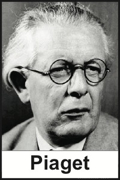
Piaget experienced reality of false memory

130104PiagetJan. 4, 2013

“Psychologist Jean Piaget reported that his earliest memory was of his nurse defending him against a potential kidnapper at age two. He distinctly recalled sitting frightened in the baby carriage while the nurse fought off the man (incurring a scratch on her face in the process), and the police officer chasing away the kidnapper with his short white baton. Piaget was even able to describe the officer’s uniform in detail. His family, relieved that the nurse had prevented his kidnapping, rewarded her with a gold watch.

“Thirteen years later, the nurse returned the gold watch to the family accompanied by a letter confessing that she had made up the story because she wanted to raise the family’s opinion of her.

“Piaget used this false memory to emphasize the role of others’ influences on one’s memories. He noted that the nurse frequently had recounted the story in his presence, and others then had repeated the story in his hearing, thus creating the memories he had adopted as his own.

“Piaget noted that even in his old age those memories persisted as clear events, even though he knew them to be false.”

– From “The Encyclopedia of the Brain and Brain Disorders” by Carol Turkington and Joseph Harris (2009)

Given this phenomenon of memory, it’s hardly surprising that no child-witness against the Edenton Seven has stepped forward to publicly recant.