View from Edenton: ‘I never considered leaving’

130429Barrow2April 29, 2013

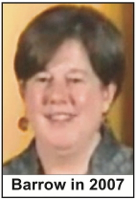
If you watched “The Plea,” the concluding 1997 installment of “Innocence Lost,” you might not expect that Nancy Smith Barrow, Betsy’s sister, would choose to remain in the midst of those townspeople who caused her family such brutal and unjustified pain.

But stay she has, raising a family and participating in community affairs. I talked to her recently about her life then and now.

Why she has continued to live in Edenton:

“I never considered leaving. My parents were here. This is my home. For a long time, I imagined my dad, mom, sister and I would be back here together, after it all unraveled, after people looked behind the curtain and saw the Wizard….”

What Edenton was like for her during the Little Rascals panic:

“I’d walk into a public place and scan the room to see if I would be comfortable there. I never felt any physical threat – that’s not the kind of people they are here…. But I didn’t want my children exposed to such obvious and outward hatred….”

What Edenton is like for her today:

“Once Bob’s verdict was overturned, that was the end of it. Now I go where I want and do what I want….

“Things went very badly for the indicting parents. But they still believe – because they have to believe….

“Some of them I will talk to in the grocery store or at school, but we are not welcome in each others’ homes….

“Our children went to school together, and they finished growing up together (without conflict). It was like when the adults went away, when the adults got tired of playing, the children were left to clean up the game….”

How she looks back at the case:

“My sister (who now lives in Raleigh) has a life we could never have imagined, a wonderfully normal life. Everyone I loved at Little Rascals is free. My children (now 32 and 28) are fine and healthy…. The Little Rascals case was a phenomenon of epic proportions, and we weathered it….”

‘Satanic ritual abuse’ loses its place in textbook

130426Perrin2April 26, 2013

By 1997, when the college textbook “Family Violence Across the Lifespan” was first published, the most grievous excesses of the day-care ritual-abuse panic had passed (although it would be two more years before Little Rascals prosecutors dropped a final, unrelated charge against Bob Kelly).

The authors, social scientists at Pepperdine University, devoted entire sections to “Do Children Fabricate Reports of Child Sexual Abuse?” and “The Satanic Ritual Abuse Controversy.” More on those issues here.

Their approach is thoughtfully skeptical, but they can’t quite bring themselves to call baloney on those peers whose ill-conceived claims ginned up the “controversy” or whose gullibility prolonged it. For example:

“If there is so little evidence confirming the existence of SRA, why do so many perceive the SRA threat to be real? One reason is that… therapists, police officers and child protection authorities, who are often required to attend seminars on current developments in their field, are exposed to SRA ‘experts’…. These seminars tend to employ proselytizing techniques characteristic of organizations seeking recruits. Many well-meaning helping professionals, who are generally motivated by the desire to help abused clients, become convinced of the existence of SRA through these seminars (such as the one at Kill Devil Hills)….”

“Family Violence…” has proved popular enough to justify a third edition (2011), in which all mention of ritual abuse has been removed.

I asked sociologist Robin D. Perrin, one of the authors, to trace his thinking on the subject between editions.

“I suppose one could argue that the ‘Satanic Ritual Abuse’ issue is a bit dated at this point,” he replied, “as the Satanism scare has mostly faded into the sunset. But it is still a fascinating page in history, if nothing else….

“As for our approach on these issues, I think ‘thoughtfully skeptical’ is probably fair. You are correct that we fall far short of an outright denial of the validity of all ritual abuse claims. I am quite certain we are not in position to do that. In fact, given the history of mistreatment of children (both ‘then’ and ‘now’) I have no doubt that ‘ritual’ abuse has occurred (depending on how it is defined, of course).”

The night Koppel redefined ‘objective and reliable’

April 24, 2013

“Ted Koppel said the idea for (a “Nightline” episode criticizing juries’ growing skepticism toward child-witnesses) had been brought to him by Civia Tamarkin, who although she ‘served on the advisory board of an organization called Believe the Children insists that she remains neutral on the subject…. We have found her to be a useful, objective and reliable source.’

“Tamarkin had indeed devoted a lot of attention to child sexual-abuse cases, along with an abiding conviction that most defendants are guilty…. She believes the McMartin prosecution should have resulted in convictions (and) has praised the prosecution in the Little Rascals case….

“I interviewed prosecutors and defense lawyers in Little Rascals and read trial transcripts. It was clear the child witnesses had been persistently manipulated….”

– From “Koppel lost his balance on child witnesses” by Washington Post columnist Nat Hentoff (Dec. 3, 1996)

Believe the Children, organized by McMartin parents, later expanded to become a clearinghouse for ritual abuse allegations. It apparently disbanded after holding a final conference in Arlington Heights, Illinois, in 1995.

Why the panic ‘needs to be remembered’

130422JenkinsApril 22, 2013

“Lecturing recently, I mentioned the American witch-hunts of the 1980s and 1990s. When the audience looked puzzled, I explained that I was referring to the Satanic Panic of those years, the wave of false charges concerning ritual child abuse and devil cults that made regular headlines in the decade after 1984. The explanation helped little.

“Even people who had lived through those years, who had been following the media closely, had precisely no recollection. Lost in memory it may be, but the Satanic Panic needs to be remembered, if only to prevent a renewed outbreak of this horrible farrago. And when better than in the 30th anniversary of the affair’s beginning?

“It all started in southern California, in Manhattan Beach, in the Fall of 1983….”

– From “Remember the Satanic Panic” (Jan. 9, 2013) by Philip Jenkins, Distinguished Professor of History at Baylor University, on Real Clear Religion

I share Dr. Jenkins’ concern about public memory, of course.

Which are more worrisome – those who have no recollection at all of cases such as McMartin and Little Rascals, or those who have forgotten they all were hoaxes?

Was there nothing to fear but ‘day care itself’?

April 19, 2013

“What can have spurred so many communities to such (ritual abuse) hysteria? The answer may be day care itself. The mothers who report that children never lie are simply unfamiliar with the ways of children. They may also feel guilty about putting their children in day care. A righteous rage against the day-care provider can certainly distract a parent from wondering whether she is doing an adequate job as a mother.”

– From “Believe the children?” by syndicated columnist Mona Charen (October 11, 2003)

Although Charen approaches the subject as a proselytizer for stay-at-home motherhood, less partisan observers also have speculated about the role of day-care guilt.

Parent said God knew better than ‘Frontline’

April 17, 2013

“One day you will stand before almighty God and be accountable for that which you have done here on Earth, and no amount of lies and manipulation, no ‘Frontline’ presentation will be able to hide the truth from him. He knows every sordid detail and I pity you for that.”

– From a statement read by Little Rascals parent Susan Small at the plea-agreement hearing of Scott Privott (June 16, 1994)

On the scale of responsibility for brutalizing the Edenton Seven, the panicked, misinformed parents may rank as least culpable. They were neither demagoguing public servants (the prosecutors) nor overreaching professionals (the therapists). Even so, Susan Small’s tirade seemed gratuitously vitriolic – as if her own beliefs might have needed reinforcing?

I asked Scott Privott what it felt like being on the receiving end that day in the courtroom.

“I almost got up and told her to shut the hell up and that I would let the state put me on trial,” he said. “I thought to myself that I was glad God would judge me and not her and her pathetic cohorts.”

Scott’s recollection of his earlier knowledge of Susan Small highlights the Lilliputian stage on which the sprawling Little Rascals drama played out:

“I was in college with Susan Small’s husband, Morris; in fact, Morris and I used to ride together from Edenton to Elizabeth City to attend classes at the College of the Albemarle. Susan was at the college too, but I didn’t know her that well. Morris was my banker at the time of my arrest.”

A third member of the car pool: Jay Swicegood, another accusing parent.

“I am not like some of those who’ve been falsely accused and hold no ill feelings,” Scott says. “I have plenty of ill feelings, and I do not for one moment wish them any good tidings.”

Idle thought: Might it mitigate Scott’s bitterness if someone – anyone! – who participated in putting him behind bars for three years and eight months had the courage to apologize?

Prosecutors went out of way to inflame public

April 15, 2013

This from Detroit reader P. Karr:

“Raised by a mom who survived the Blitz of London, I was taught that fascism often appears at the hands of lawmakers and is then carried forth by the public at large – said public believing whatever convenient lie is crammed down its throat….

“The Edenton prosecutors’ refusal to apply reason was frightening. But not near as frightening as their hubris, their moral flogging of the accused and their trotting them out in order to inflame the public. They may as well have sewn gold stars on the shirts of the Edenton Seven….

“I wonder if it ever occurs to the prosecutors that a refusal to apologize – indeed, to even question if they may have been wrong – is the hallmark of the sociopath.

“Something tells me not.”

‘If somebody killed a rabbit at my day care…’

April 12, 2013

In January 1993, supporters of the Edenton Seven held a press conference in Hertford to demand that North Carolina authorities bring to an end – in the words of Raymond Lawrence – “this continuing social catastrophe.”

Also speaking out were Doug Wiik of Langhorne, Pa., a day care owner who survived a close call with the mania, and Susan Corbett, director of a day care in Richmond, Va.

Ms. Corbett’s contribution also included weekly letters to Dawn Wilson while she was imprisoned and gifts for her baby at Easter.

Now retired, Ms. Corbett says she recognized immediately that the Little Rascals charges were preposterous: “There was no question in my mind. If somebody killed a rabbit at my day care, everybody in town would know it in 24 hours.”

So why did so many others succumb?

“I think people uncomfortable with sexuality bought into it more easily. The Bible Belt, the right wing and a perverted, anti-sexual stage of feminism all came together…. And the world of social work was being sold a bill of goods at that time – all that crap with (anatomically correct) dolls.”

Therapists were naïve in use of dolls

111125TalbotApril 10, 2013

“Consider the use of anatomically detailed dolls to prompt shy or frightened children to reveal abuse. This was an innovation of the 1970s, and at first it certainly seemed like an effective and compassionate one.

“But more recent studies have cast doubt on whether these dolls prompt more accurate recall, especially for the pre-schoolage children for whom they are usually deployed.

“The doll is supposed to be a body double for the child him- or herself; but since the vast majority of children this age lack the symbolic thinking required to make such a connection– most two- and three-year-olds, for example, cannot see the relation between a room and a scale model of it – this proposition turns out to be rather dubious.

“More to the point, it seems that some children who have not been sexually abused will also play with an anatomically detailed doll in sexually suggestive ways – promptly removing its clothes, touching or grabbing its ‘genitals,’ sticking their fingers into various orifices. As the authors of one study judiciously put it, the ‘average amount of sexualized doll play by presumably non-abused children is not alarming, but there is enough of it to be potentially problematic in clinical or forensic situations.’

“In other words, if you are prepared to see signs of abuse, you may see them even in behavior that, in other contexts or at other times, would be attributed to normal sexual curiosity.

“And this is precisely the issue: At a time when there was comparatively little data available on what constituted normal sexuality in children, this vacuum was filled by people with a very narrow view of the possibilities.”

– From “Against Innocence: The truth about child abuse and the truth about children” by Margaret Talbot in The New Republic (March 15, 1999)

Prosecution therapists in the Little Rascals case made extensive use of anatomically correct dolls. During Bob Kelly’s trial, therapist Janet Hadler of Chapel Hill showed a video clip of a 5-year-old girl pressing together the pelvises of a male and a female doll. “Children who are demonstrating explicit sexual contact,” Hadler testified confidently, “are doing that because they have some knowledge of adult sexual behavior.”

Panics fade, ‘leaving in their wake bewilderment’

April 8, 2013

“The panic over satanic ritual abuse in the United States… subsided rather abruptly, as panics usually do, whether they are individual or social. They are like an acute anxiety attack – absolutely absorbing while in course and then suddenly gone, leaving in their wake bewilderment, fear of confronting the causes of the panic, and bafflement about what just happened….

“But traces of its presence can be found without much difficulty in the child abuse and neglect (CAN) literature. The panic, and the way CAN personnel had contributed to it, made the field more self-reflective and self-questioning. CAN practitioners had been shocked by the spectacle of their colleagues battling one another in courtrooms… unable to distinguish between real events of abuse and mass hysteria over alleged satanic abuse.”

– From “Childism: Confronting Prejudice Against Children” by Elisabeth Young-Bruehl (2012)


“More self-reflecting and self-questioning” may describe the current generation of child abuse professionals, but those who did such unspeakable damage in the 1980s and ’90s remain wedded to their junk science.