SRA apologists flushed from their diploma-papered caves

140322TimesFrontMarch 22, 2014

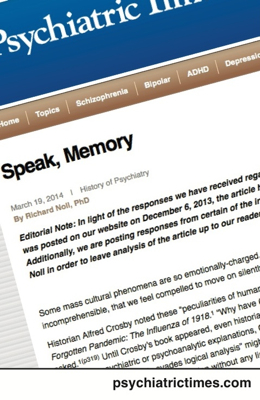
“Editorial Note: In light of the responses we have received regarding this article by Richard Noll, PhD, that was posted on our website on December 6, 2013, the article has been reposted with a modification. Additionally, we are posting responses from certain of the individuals mentioned in the article and from Dr. Noll in order to leave analysis of the article up to our readers.”

– From “Speak, Memory,” Psychiatric Times’ reposted version of Noll’s “When Psychiatry Battled the Devil.”

As pointed out at 1 boring old man, PT’s belated reposting omits this passage:

“New (American Psychiatric Association) work groups for the preparation of DSM-IV were formed. Not surprisingly, none of the former members of the DSM-III-R Advisory Committee on Dissociate Disorders was invited to be on the work group for the dissociative disorders.”

Prominent among those uninvitees, of course, were Dr. Richard Kluft and Dr. Bennett Braun, both of whom broke their silence to accept PT’s offer of space to swat back at Noll. Also responding: Dr. David Spiegel, recently described as “the most influential man responsible” for the inclusion of DID/MPD in DSM-V.

And now Noll has gently rebutted – for the most part, refuted – the SRA apologists’ noisy rebuttals.

It’s been 25 years since the fever-breaking Chicago conference – plus another three months while Psychiatric Times searched its soul and its appetite for litigation. Does the vigorous exchange on the PT site mark the beginning of psychiatry’s overdue reexamination of its SRA era?

If so, that discussion must address not only the causes of the moral panic but also its effects: that is, the wrongful and brutal prosecution of hundreds of innocent defendants such as the Edenton Seven – a subject Kluft, Braun and Spiegel managed to mention not at all in their responses. Are they really so oblivious?
Too bad ‘True Detective’ chose to mislead, not to enlighten

140315CamposMarch 15, 2014

“In an interview with Entertainment Weekly (True Detective creator Nic) Pizzolato responded to a question about the inspiration for the show: ‘You can Google “Satanism” “preschool” and “Louisiana” and you’ll be surprised at what you get.’

“This is clearly a reference to a 2005 child abuse prosecution in Ponchataoula, Louisiana, that generated lurid international headlines about ritualistic Satan worship inside a church, complete with black robes, animal blood, orgies, and pentagrams.

“This has since led various media sources to report breathlessly on the ‘true story’ behind True Detective. The problem is that this ‘true story’ turns out to be completely false, at least in regard to all the details regarding Satanic ritual abuse.

“These were apparently part of a classic atrocity story, invented by the defendants to garner sympathy from jurors – the idea being that the defendants were victims of an unspeakably evil church-based mind control cult, rather than merely being banally evil and not very interesting child molesters.

“What sort of moral responsibility do artists have not to exploit, and thereby perhaps propagate, moral panics? The aesthetic power of The Birth of a Nation and Triumph of the Will has not absolved their creators for choosing to exploit racist and anti-Semitic beliefs.

“Our shameful history of panics and persecutions over the imaginary satanic ritual abuse of children should have been treated by artists as talented as the makers of True Detectiveas a cautionary tale, rather than as an opportunity for further invidious myth-making.”

– From “True Detective’s dangerous lies about satanic ritual abuse” by Paul Campos at The Week (March 12)

I’m surprised to find myself cutting the just-concluded HBO series a bit more slack than Campos, a law professor at the University of Colorado. But True Detective’s potential for doing harm in 2014 seems minimal compared with the hysterically alarmist Do You Know the Muffin Man? which aired on Lifetime while arrests were still being made in the Little Rascals case.

New York Times remembers McMartin case

140312HabermanMarch 12, 2014

“Really now, teachers chopped up animals, clubbed a horse to death with a baseball bat, sacrificed a baby in a church and made children drink the blood, dressed up as witches and flew in the air – and all this had been going on unnoticed for a good long while until a disturbed mother spoke up?”

– From “The Trial That Unleashed Hysteria Over Child Abuse” by Clyde Haberman in the New York Times (March 9, 2014)

Big thanks to Retro Report for its eye-reopening essay and 13-minute video recalling the seminal McMartin Preschool case. Also mentioned are Little Rascals and other “criminal cases of dubious provenance” from the moral panic.

Although the road to public exoneration for the Edenton Seven remains long and uncertain, this attention from the Times is welcome indeed.

Why SRA authors might’ve passed on responding

March 8, 2014

Last of three posts

As I recounted earlier, Dr. Jon Conte expressed a willingness to consider my expanded letter seeking a retraction of the Journal of Interpersonal Violence’s past support of the “satanic ritual abuse” moral panic. So what might have happened after I submitted that October 25 letter that resulted in Conte’s cutting off contact by email or phone?

I suspect the crucial clue lies in his specifying that “We are probably going to invite the authors to respond, and if they choose to do so I will share their responses before we publish your letter or their responses.” Those authors would include Susan J. Kelley (“Stress Responses of Children to Sexual Abuse and Ritualistic Abuse in Day Care Centers,” December 1989) and Barbara Snow (“Ritualistic Child Abuse in a Neighborhood Setting,” December 1990).

Kelley has been oft-recognized at littlerascalsdaycarecase.org, not only for her enthusiastically wrongheaded academic work, but also for her prosecutorial interviewing techniques in the Fells Acres case.

Unlike Kelley, Snow eventually suffered consequences, however small. From the Salt Lake Tribune (February 22, 2008):

“A therapist accused of unprofessional conduct – including imposing false memories on her relatives – entered into an agreement Tuesday with (Utah’s) Division of Occupational and Professional Licensing.

“Barbara Snow is voluntarily being placed on probation, according to a statement from her attorney….

“The disciplinary notice alleged Snow convinced a male relative he was sexually abused by his father. It also contended Snow convinced a female relative she was the victim of satanic abuse and military testing. When state investigators questioned Snow, she allegedly provided made-up notes about those sessions.

“In the agreement, Snow admitted destroying a relative’s computer equipment (with a baseball bat!) and adding two incorrect dates to her psychotherapy notes….

“Snow was involved in the prosecutions of a string of child sex abuse cases in the 1980s. One man she testified against was granted a new hearing after the Utah Supreme Court questioned her credibility….”

Should it surprise anyone that Kelley and Snow – or Dr. Richard Kluft – would be less than eager to look back at the toxic misconceptions they spread?

A funny thing happened on the way to publication

March 7, 2014

Second of three posts

After our lengthy email exchange I took up editor Jon Conte on his offer to consider an expanded letter challenging the Journal of Interpersonal Violence’s past support of the “satanic ritual abuse” moral panic.

This is what I submitted on Oct. 25, 2013:

To the editor:

In December 1989 the Journal of Interpersonal Violence published “Stress Responses of Children to Sexual Abuse and Ritualistic Abuse in Day Care Centers” by Susan J. Kelley. In December 1990 it published “Ritualistic Child Abuse in a Neighborhood Setting” by Barbara Snow and Teena Sorensen. Both these articles endorsed, promoted and attempted to substantiate a concept that subsequent research has proven to be a quintessential moral panic. Today no respected social scientist will argue that satanic (or sadistic) ritual abuse ever existed in the nation’s day cares.

These articles in JIV, however, were unequivocally confident that it not only existed but also was widespread. From Kelley’s synopsis: “The purpose of this study was to examine the effects of sexual abuse and ritualistic abuse of children in day care settings. The sample was composed of 134 children; 67 children who were sexually abused and ritually abused in day care centers were compared on the Child Behavior Checklist with a carefully matched group of 67 nonabused children. Findings indicated that sexually abused children had significantly more behavior problems than did the nonabused children. Sexual abuse involving ritualistic abuse was associated with increased impact as well as increased severity in the extent of the sexual, physical, and psychological abuse the children experienced.”

Snow and Sorensen criticized “attempts to discredit victims and therapists” and seemed unaware that they were exposing the corruption of those therapists’ interviewing techniques when they wrote: “Disclosures were difficult and progressed slowly. The majority of children showed little symptomology at initial referral with significant increases during the disclosure process.”

The Little Rascals and McMartin cases were but two manifestations of this moral panic of  the 1980s and early 1990s. Dozens of less publicized prosecutions occurred across North America and as far away as New Zealand and Germany. The extensive literature illuminating the day care moral panic includes “Satanic Panic: The Creation of a Contemporary Legend” by Jeffrey S. Victor, “Sex Panic and the Punitive State” by Roger N. Lancaster, “Moral Panic: Changing Concepts of the Child Molester in Modern America” by Philip Jenkins, “The Satanism Scare” by David G. Bromley, Joel Best and James T. Richardson, “Moral Panics: The Social Construction of Deviance ” by Erich Goode and Nachman Ben-Yehuda, “The Day Care Ritual Abuse Moral Panic” by Mary De Young and the latest edition of “Folk Devils and Moral Panics”  by Stanley Cohen – who coined the term “moral panic” in 1972.

The Wall Street Journal’s Dorothy Rabinowitz won a Pulitzer Prize for her coverage of the Wee Care Day Nursery case in 1985. Among law enforcement reports debunking ritual abuse allegations the best known is “Investigator’s Guide to Allegations of ‘Ritual’ Child Abuse” by Kenneth Lanning, the FBI agent in the Behavioral Science Unit assigned to examine these cases. Similar reports have been issued in countries such as England (“Extent and Nature of Organised and Ritual Abuse” byJ. S. La Fontaine), the Netherlands (“Report of the Ritual Abuse Workgroup”) and Australia (“Royal Commission into the New South Wales Police Service”).

Eventually the convictions of most of the day care providers in the United States were overturned.  Playing a major part in alerting appellate courts to the suggestibility of child witnesses was an amicus brief filed in the Wee Care case by pioneer researchers Stephen Ceci and Maggie Bruck.

Before the fever broke, however, untold harm was done to defendants,  families and child-witnesses. In the words of sociologist Mary De Young:

“Innocent people have been accused and convicted; the autobiographies of children have been usurped (and some children, now adults, have completely retracted their allegations); professional reputations have been destroyed (and some of the loudest proponents of the idea of ritual abuse have since retracted their claims); tens of millions of dollars were wasted on investigations and trials; it distracted attention, time, money and energy from ‘real’ cases of sexual abuse and from the fathers, brothers and other family members who most likely were the perpetrators; it made quality day care harder to find and drove out male providers who could have been valuable role models to children, especially boys; it eroticized abuse by focusing on rituals and masked and hooded perpetrators; it added nothing – absolutely nothing – to a clinical or scientific understanding of the traumatic effects of abuse because the trauma children experienced in these cases was iatrogenic, i.e., caused by investigators, interviewers, prosecutors and hysterical parents; it broke up families; and even dropped property values and interfered with commerce; and it introduced distrust, cynicism and incivility into our lives and into legitimate work on helping abused kids.”

The Journal of Interpersonal Violence should not allow these misguided articles from 1989 and 1990 to stand as its last word on claims of day-care ritual abuse.

Lew Powell

Charlotte, North Carolina

Alas, publication in the JIV now seems unlikely. Dr. Conte has not responded to my follow-up emails and phone messages over the past four months.  Why might that be?

Next: I’ll consider some possible answers.

What? A journal willing to retract?

140305Conte2March 6, 2014

First of three posts

Psychiatric Times isn’t the only professional journal to avoid reexamining the “satanic ritual abuse” era.

Other examples include Nursing ResearchChild Abuse & Neglect and Relational Child and Youth Care Practice. The editors of each of these journals turned down my requests to retract their articles supporting and promoting the SRA moral panic.

One editor did offer a glimmer of willingness: Jon Conte at the Journal of Interpersonal Violence.

The road to publication, however, has proved long and bumpy and ultimately – spoiler alert – a dead end.

Here are excerpts from my correspondence with Dr. Conte, who is a professor in the School of Social Work, University of Washington:

Powell (Oct. 30, 2012):

Hello Dr. Conte….

I am an independent researcher and blogger in Charlotte, North Carolina. My goal is to obtain a statement of innocence for the Edenton Seven, the wrongfully prosecuted defendants in the Little Rascals Day Care case (1989-1997).

In December 1989 the Journal of Interpersonal Violence published the article “Stress Responses of Children to Sexual Abuse and Ritualistic Abuse in Day Care Centers” by Susan J. Kelley.

In December 1990 the Journal published the article “Ritualistic Child Abuse in a Neighborhood Setting” by Barbara Snow and Teena Sorensen.

Can you tell me whether the Journal ever published a retraction for these articles? And if not, would it consider doing so now?

Conte (Oct. 30, 2012):

I do not believe JIV (ever) published a Comment on this 1989 manuscript.  I would not prejudge any submission so long
as it is consistent with the overall mission and focus of the journal.  A comment on a previous article, even years after publication would certainly be reviewed.  Any submission must be scholarly and consistent with the purpose of knowledge development or dissemination.  Your use of the term “recantation” (actually, “retraction”) would appear to suggest an advocacy purpose and that purpose alone would not be appropriate for a manuscript we would review.

Powell (Nov. 12, 2012):

I apologize for not having been clearer in my request.

What I am seeking is not a recantation but a simple, concise retraction by the editors, acknowledging that the concept accepted and promoted in these two articles – ritual abuse in day cares –  was in fact entirely a product of a moral panic.

I am not an academic or professional, but I believe an examination of the literature in the intervening years would fully support such a retraction.

This passage is from the Retraction Guidelines of the Committee on Publication Ethics: “Retraction is a mechanism for correcting the literature and alerting readers to publications that contain such seriously flawed or erroneous data that their findings and conclusions cannot be relied upon. Unreliable data may result from honest error or from research misconduct.”

Does the Journal of Interpersonal Violence want to leave these articles as its last word on the era of unfounded claims of ritual abuse in day cares?

Conte (Nov. 13, 2012):

As I said before we would accept a letter to the Editor or longer manuscript.  The letter would not be peer reviewed.
The longer manuscript would be.

Science and knowledge progress slowly.  There are many things which are published in good faith, blindly reviewed, and found acceptable for publication.  Then some years later with more research, experience, or knowledge what was once acceptable is seen in a new light.  I am not saying this has taken place with the manuscript you have identified.  It is not my intent to review previously published work in light of the change in times.

If you wish to write a letter for publication I am happy to work with you in that effort.

Powell  (Nov. 13, 2012):

I appreciate your thoughtful response. As much I would prefer a retraction – professionally researched and peer-reviewed – I appreciate your offer to consider a letter to the editor. Here is what I’d like to say:

“In December 1989 the Journal of Interpersonal Violence published ‘Stress Responses of Children to Sexual Abuse and
Ritualistic Abuse in Day Care Centers’ by Susan J. Kelley.

“In December 1990 it published ‘Ritualistic Child Abuse in a Neighborhood Setting’ by Barbara Snow and Teena
Sorensen.

“Both these articles endorsed and promoted a concept – satanic (or sadistic) ritual abuse in day cares – that subsequent research has proven to be entirely false. Today no respected social scientist will argue otherwise.

“The Little Rascals and McMartin cases were but two manifestations of this moral panic of  the 1980s and early 1990s. Less publicized prosecutions occurred across North America and as far away as New Zealand and Germany.

“Untold harm was done to defendants, families and child-witnesses.

“The Journal of Interpersonal Violence should not allow these articles to stand as its last word on claims of day-care ritual abuse.”

Conte (Jan. 18, 2013):

I would suggest you consider several additional points:  1) you cite research which proves ritual abuse “false.”  I don’t think you need to do a comprehensive research review, but since JIV is a scholarly journal, you should cite some of the research you are referring to.  I am not sure that this research “proves” that RA does not exist but rather raises questions.

You might also make reference (if true) that no law enforcement investigation has every uncovered evidence that such “cults” exist.  You also need to specify the harm that you feel these articles did.  For example, does the term RA in the title imply belief that RA exists?  I don’t think you have to prove some harm, but be specific in what you believe the harm is.

Also, and perhaps more importantly, if there are issues within the articles (i.e., not just the title) then describe what you see as the conceptual, methodological, etc., problems.

We are probably going to invite the authors to respond, and if they choose to do so I will share their responses
before we publish your letter or their responses.

Powell (Jan. 25, 2013):

I appreciate your guidelines and hope to produce something that is not only publishable but also contributes to discussion of this issue.

Conte (Sept. 4,  2013):

I am happy to work with you….

Next: My second attempt to make my case in the Journal of Interpersonal Violence.

Richard Kluft, ‘advocate of moderation’?

140228GreenbergFeb. 28, 2014

As noted by Gary Greenberg, Richard Noll’s disappeared history of psychiatry and satanic ritual abuse “singles out two psychiatrists – Bennett Braun and Richard Kluft – who were instrumental in giving legitimacy to the SRA accounts. They helped change the DSM to make Multiple Personality Disorder (thought to be caused by the abuse) seem more common, they started the International Society for the Study of Multiple Personality and Dissociation, and they founded a journal called Dissociation….”

If the SRA era was psychiatry’s Wild West, then Braun and Kluft were… who? Butch and Sundance? Or Frank and Jesse?

In “Rewriting the Soul: Multiple Personality and the Sciences of Memory” (1995) philosopher Ian Hacking pointed out an editorial in Dissociation in which Kluft “pleaded for moderation, but…  acknowledged that powerful emotions were at work. He also raised the stakes by printing a comparison that I find rather odious. He noted that one party refers to Nazis and the Holocaust, asking, ‘Should he or she be silent, emulating the “good Germans” who did not speak out about the atrocities in their midst, and by his or her silence become a facilitator?’”

Despite such overheated comparisons, and his ludicrous estimates of an epidemic of  “multiples,” Kluft at least claimed “moderation”  – not so Braun, whose excesses in patient treatment led to suspension of his Illinois medical license, closure of his hospital MPD unit and at least four out-of-court settlements, one for $10.6 million.

Today he practices in obscurity, while Kluft concentrates on stifling publication of incriminating journal articles.

C’mon, Dr. Kluft, aren’t you proud of your role?

140224KluftFeb. 24, 2014

Why would Dr. Richard Kluft “take exception to” and “(raise) the issue of legal liability” over “When Psychiatry Battled the Devil”?

It’s not as if the record of Kluft’s involvement in promoting “satanic ritual abuse” and “multiple personality disorder” could be any longer or better-documented.

And it’s certainly not as if he has ever acknowledged the error of his ways.

In this exchange from a 2009 interview on CBS “Sunday Morning” he confidently posits a nationwide epidemic of undiagnosed cases of MPD:

Tracy Smith: So do you think that there are, what, thousands of people walking around out there with MPD who don`t even know it?

Kluft: Oh, easily.

Smith: Tens of thousands?

Kluft: Easily.

Smith: Hundreds of thousands?

Kluft: Easily.

Smith: Millions?

Kluft: We might be at that level.

Passing off such fantasy as expertise would be knee-slappingly funny, of course, had it not typified the thinking that fostered scores of wrongful prosecutions and ruined thousands of lives….

I remain baffled – what exactly has Richard Kluft done to deserve such obeisance from Psychiatric Times?

In search of a ‘frank and unblinking appraisal’

140220GutheilFeb. 20, 2014

Following up on the curious case of Richard Noll v. Psychiatric Times, I wrote editor-in-chief James L. Knoll IV to ask about the removal of Dr. Noll’s “satanic ritual abuse” essay from the Psychiatric Times website.

Did the journal plan to address in some fashion the issues raised in Dr.
Noll’s piece? “Unfortunately, I am not at liberty to comment on the situation,” Dr. Knoll replied.

Next I turned to Psychiatric Times’ editorial board, described on the site as “(not) just figureheads with impressive résumés…. They give us their frank and unblinking appraisal of the contents of each and every issue….”

This is from a letter I sent to 22 PT board members:

“I am writing you in response to Dr. Allen Frances’s call for psychiatrists to ‘step forward and do the right thing’ about the profession’s failure to confront the ‘satanic ritual abuse’ claims of the 1980s and early ’90s.

“As you know, Psychiatric Times removed from its website Dr. Richard Noll’s history of the SRA era….

“Dr. Noll concluded by asking: ‘Are we ready now to reopen a discussion on this moral panic? Will both clinicians and historians of psychiatry be willing to be on record? Shall we continue to silence memory, or allow it to speak?’

“How do you, as a member of the Psychiatric Times editorial board, answer these questions?

“Would you now be willing to join with Dr. Frances in formally setting the record straight about SRA and in making amends to the scores of wrongfully prosecuted victims of the moral panic?”

So far I have not been overwhelmed with responses to these questions. In fact, I have received only a single “frank and unblinking appraisal” – from Thomas G. Gutheil, professor of psychiatry, Beth Israel Deaconess Medical Center, Harvard
Medical School.

“I do agree (with Dr. Frances),” he writes. “The 1992 FBI report compiled by Kenneth Lanning should have put an end to this, when he investigated many claimed cases from law enforcement viewpoint and in multiple cases found not a shred of physical evidence, DNA, cells or bloodstains from butchered babies or sacrificed virgins.

“The problem is that social viruses like this are hard to assess and halt, like their biologic counterparts. I agree that individuals, especially in the legal system, should own up to their serious errors and miscarriages of justice, since improved science has blown up many claims, yet some prosecutors (e.g., Martha Coakley in Mass.) have not reversed themselves nor freed the imprisoned.

“However, I am not sure the entire mental health professions should share the blame.”

To be sure, distribution of responsibility among the professions is uneven – the Little Rascals prosecutors called on no psychiatrists at all, only psychologists, off-brand psychotherapists, etc.

Psychiatric Times clings to embarrassing position

140214OranskyFeb. 14, 2014

Thanks to Ivan Oransky at Retraction Watch for spotlighting Psychiatric Times’ remarkably inept retraction of Richard Noll’s “When Psychiatry Battled the Devil.”

Don’t miss the update appended by Dr. Noll:

“On 16 January 2014 I received a gracious email from PT’s editor-in-chief, Dr. James Knoll, updating me on the status of my submission. This message cleared up the mystery of the published article’s disappearance from PT.

“According to Dr. Knoll, ‘In an effort to present both sides, PT contacted Dr. (Richard) Kluft (of Philadelphia). Please know that not only did he take exception to a number of your points, but he also raised the issue of legal liability. We are currently in the process of confirming that Dr. Kluft is willing to write a rejoinder to your piece.’

“Apparently he refused. About 10 days later I received another email from Dr. Knoll telling me that the reposting of my piece was to be put on hold at the advice of their attorneys. He did not outright reject the possibility it would be reposted, but I have heard nothing since….”

Followers of Retraction Watch – or even of littlerascalsdaycarecase.org – are not surprised to see editors go to absurd lengths to avoid candid correction. But the behavior of Psychiatric Times, billed as the most widely read psychiatric publication and boasting a lengthily-credentialed editorial board, seems especially unbecoming – even pusillanimous.

Dr. Kluft? Dr.Knoll? Can’t you do better?